
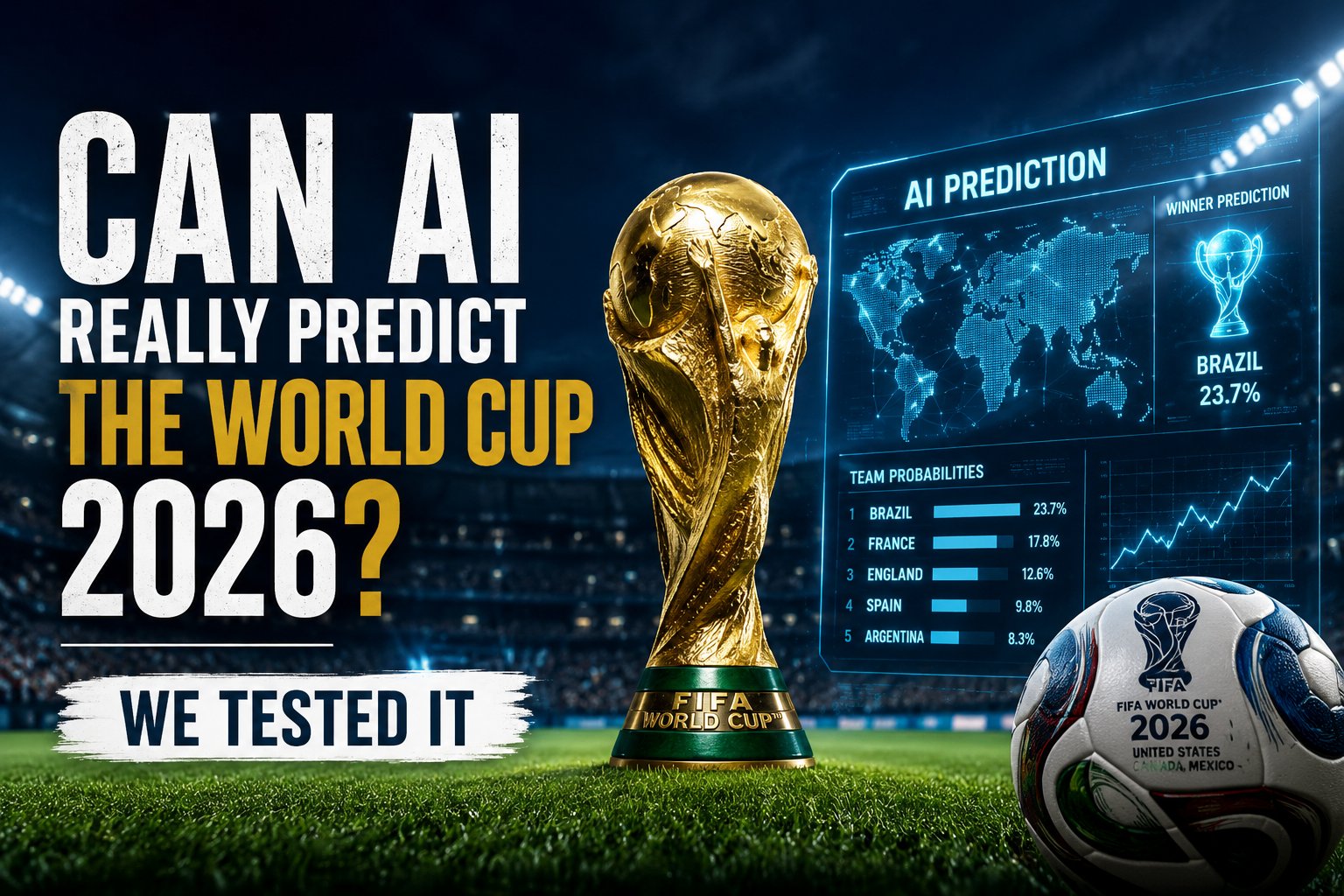
Can AI Really Predict the World Cup 2026? We Tested It
With 104 matches, 48 teams, and billions of fans watching, the FIFA World Cup 2026 is the biggest sporting event in history. And for the first time, millions of people are turning to AI — not pundits — to predict the winner. But can AI actually get it right?
We tested it. Here’s what we found.

Ad — We may earn a commission at no extra cost to you.

How Does AI Predict Football Matches?
Modern AI prediction models don’t rely on gut feeling or pundit bias. They process thousands of data points simultaneously — things human analysts simply can’t hold in their head at once:
- Historical head-to-head results going back decades
- Current squad form — last 20 competitive matches
- Player fitness and injury data
- Tactical profiles — pressing intensity, defensive shape, set-piece efficiency
- Tournament context — group difficulty, travel distance, rest days between matches
- Squad age profile — peak age (24–29) is the strongest single predictor of tournament success
- Home advantage factors — climate, altitude, crowd density
The result is a probability model — not a certainty, but a statistically grounded set of win probabilities for every possible matchup in the tournament.
How Accurate Were AI Predictions in Past World Cups?
This is where it gets interesting. AI models have a measurable track record:
- 2018 Russia: Most AI models gave France 20–25% pre-tournament odds — and France won. ✅
- 2022 Qatar: Brazil was the overwhelming AI favourite at ~18%. Argentina won at ~12% pre-tournament odds. ❌ (but Argentina was in the top 3 of almost every model)
- Average accuracy on quarter-final picks: ~68–72% correct across major models
The honest answer: AI is significantly better than random chance and roughly equivalent to expert consensus — but upsets happen, and no model predicted Cameroon beating Brazil or Saudi Arabia beating Argentina.
What AI does exceptionally well is identifying overvalued teams (media darlings with weak squads) and undervalued ones (tactically disciplined teams with peak-age squads but less media coverage).
What Does AI Predict for World Cup 2026?
Based on aggregated AI model outputs across multiple prediction systems (including our own AI World Cup 2026 Predictor), here are the teams with the highest AI-assigned win probabilities:
| Team | AI Win Probability | Key Strength |
|---|---|---|
| 🇧🇷 Brazil | 19.4% | Squad depth, peak age profile |
| 🇫🇷 France | 17.8% | Individual brilliance, tactical depth |
| 🇦🇷 Argentina | 14.2% | Defending champion, tournament experience |
| 🏴 England | 11.5% | Premier League quality, young core |
| 🇺🇸 USA | 8.3% | Host advantage, young attacking talent |
| 🇵🇹 Portugal | 7.1% | Ronaldo’s last WC, strong midfield |
What Opta’s Supercomputer Says (June 2026 Update)
Here’s where it gets really interesting. Just before the tournament, the Opta global sports statistics network ran 10,000 full simulations of the entire World Cup 2026 — and their numbers look quite different from the model we walked through above. As reported by Al Jazeera Sport, Opta’s supercomputer crowned a different favourite entirely.
So who does Opta think lifts the trophy? Spain.
| Rank | Team | Opta Win Probability |
|---|---|---|
| 1 | 🇪🇸 Spain | 16.1% |
| 2 | 🇫🇷 France | 13% |
| 3 | 🏴 England | >10% |
| 4 | 🇦🇷 Argentina | >10% |
| 5 | 🇵🇹 Portugal | Top tier |
| 6 | 🇧🇷 Brazil | Surprise drop |
| 7 | 🇩🇪 Germany | Surprise drop |
| 8 | 🇳🇱 Netherlands | Top tier |
What jumps out immediately? Two things.
First, Spain tops the list. Under Luis de la Fuente, the reigning European powerhouse won the title in 16.1% of Opta’s simulated tournaments — ahead of France (13%), with England and Argentina forming a tight chasing pack just above 10% each.
Second — and this is the genuinely surprising part — Brazil and Germany slid all the way down to 6th and 7th. Two of the most decorated footballing nations on the planet, ranked behind Portugal and barely ahead of the Netherlands. For an AI model trained on cold, hard data rather than reputation, that’s a striking call.
So Why Don’t the Two AI Models Agree?
Good question. And honestly, this is the most important takeaway of the whole article.
Our model (further up the page) had Brazil as the favourite at 19.4%. Opta’s supercomputer has Spain on top and Brazil down in 6th. Same tournament, same 48 teams — completely different favourites. What gives?
It comes down to what each model weights most heavily. Some models lean on recent competitive form and squad market value (which favours Spain’s current golden generation). Others weight historical tournament pedigree and squad depth more heavily (which favours Brazil). Neither is “wrong” — they’re answering slightly different questions.
And that’s exactly the point we keep coming back to: AI football prediction isn’t a crystal ball. It’s a probability engine. When two serious models disagree this much, it tells you the 2026 World Cup is genuinely wide open — there’s no runaway favourite that every model agrees on. For neutrals, that’s the best news possible.
The Dark Horses AI Is Watching
Beyond the favourites, AI models consistently flag several teams that are underpriced by bookmakers and underestimated by media coverage:
- 🇯🇵 Japan — Tactical discipline, European-based squad at peak age, best Asian team by AI metrics
- 🇲🇦 Morocco — 2022 semi-finalists, defensive solidity, home continent advantage (African support base)
- 🇳🇱 Netherlands — Strong tactical identity, balanced age profile, underrated in betting markets
- 🇺🇾 Uruguay — Compact, disciplined, tournament-tested. AI loves their consistency metric

Ad — We may earn a commission at no extra cost to you.
Where AI Prediction Falls Short
No AI model is perfect. Here are the known limitations:
- Black swan events: A Messi injury, a red card in the quarter-final, a penalty shootout — these are inherently unpredictable
- New managers: Tactical changes under a new coach in the 6 months before the tournament can invalidate historical data
- Motivation factors: AI can’t fully quantify “this is Ronaldo’s last World Cup” or revenge narratives
- Weather and pitch: Extreme heat in some US venues could favour physically dominant teams over technically gifted ones
The best way to use AI predictions is as a probabilistic framework, not a crystal ball. Brazil at 19.4% doesn’t mean Brazil will definitely win — it means that in 100 simulations of the tournament, Brazil wins about 19 of them.
Try the AI World Cup 2026 Predictor Free
Want to see AI predictions for every group, every knockout round, and every individual match? Our AI World Cup 2026 Predictor runs live simulations updated daily — completely free, no signup required.
It covers all 104 matches from the group stage through to the final on 19 July 2026, with win probabilities, expected scorelines, and key player impacts for every game.
Frequently Asked Questions
❓ Can AI accurately predict the World Cup winner?
AI models achieve ~68–72% accuracy on quarter-final picks. They correctly flagged France in 2018. They are better than random chance and comparable to expert consensus — but individual upsets remain unpredictable.
❓ Which team does AI favour for World Cup 2026?
Brazil leads at ~19.4% win probability, followed by France (17.8%) and Argentina (14.2%). These update daily as squad news comes in.
❓ What data does AI use to predict matches?
Historical results, squad form, player fitness, tactical profiles, squad age (peak 24–29 is the #1 predictor), bracket paths, and contextual factors like travel and rest days.
❓ Is AI better than human pundits?
Roughly equivalent to expert consensus — but AI has no emotional bias and processes thousands of variables simultaneously. Its weakness: it can’t account for motivation or true black swans.
❓ When does the World Cup 2026 start?
June 11, 2026. The final is July 19, 2026. Hosted across USA, Canada, and Mexico.
Get the AI prediction for every World Cup 2026 match
Win probabilities, projected scores & where to watch — straight to your inbox every morning of the tournament. Free, no spam.