How to Write Blog Posts 10x Faster With AI in 2026 (Proven Workflow)
Here’s a brutal truth: 94% of marketers are still writing blog content like it’s 2015, spending 3-4 hours per post while their AI-savvy competitors write blog posts in 20 minutes and dominate search rankings. If you’re not leveraging AI to accelerate your content creation in 2026, you’re not just behind — you’re practically invisible.
The content game has fundamentally changed. While traditional writers struggle with writer’s block and research paralysis, smart marketers are using AI to generate months of high-quality content in days. This isn’t about replacing creativity — it’s about amplifying it and eliminating the mundane tasks that kill productivity.
Why Traditional Blog Writing is Dead in 2026
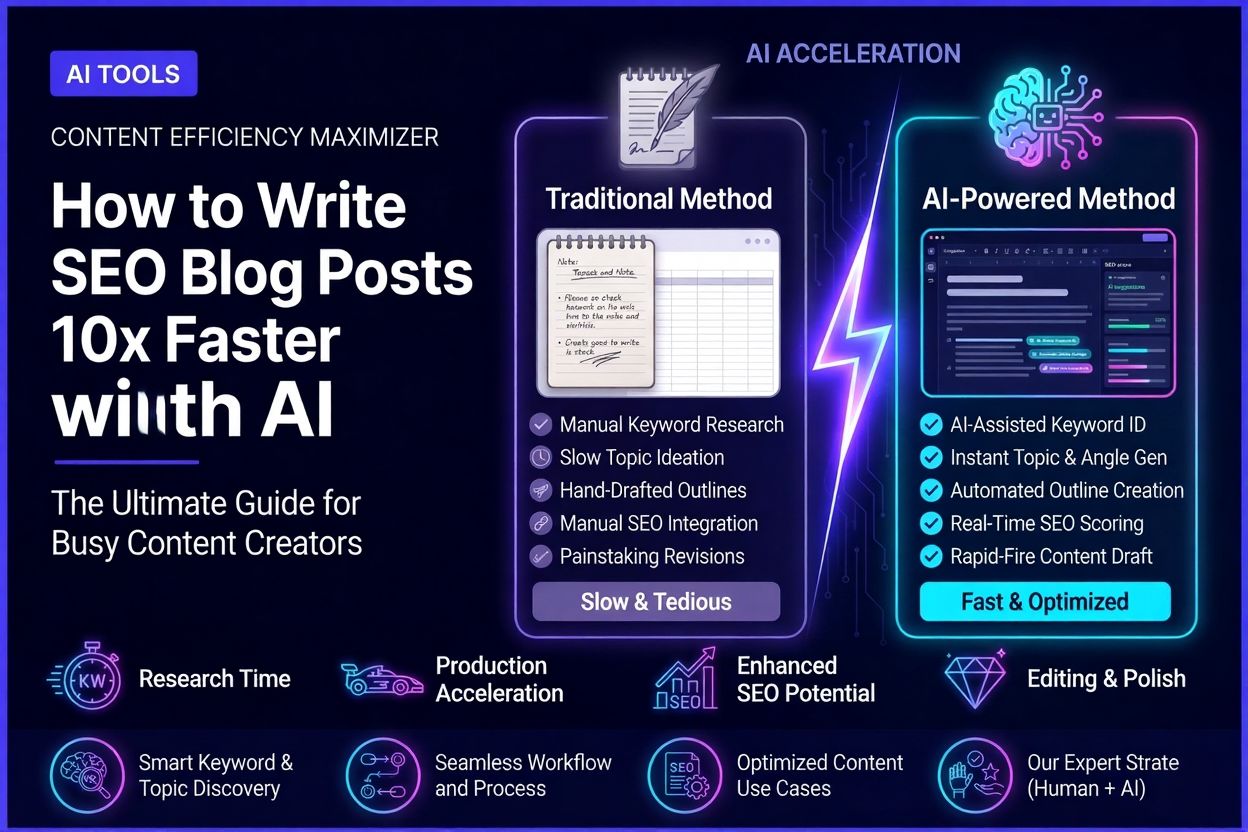
The old blog writing process is painfully inefficient. Research for hours, stare at blank screens, write linearly from intro to conclusion, then spend another hour editing. Meanwhile, AI-powered writers are publishing 10x more content with better engagement metrics.
Search engines now reward consistency and depth over perfection. Google’s 2026 algorithm updates favor sites that publish frequently while maintaining quality. The businesses winning this game aren’t necessarily better writers — they’re better systems builders.
Traditional content creation bottlenecks include:
- Research rabbit holes that consume hours without clear direction
- Perfectionism paralysis that prevents publishing
- Linear writing that ignores how readers actually consume content
- Manual SEO optimization that misses critical opportunities
The AI Content Creation Framework That Changes Everything
Smart content creators use a systematic approach that leverages AI at every stage. This isn’t about prompting ChatGPT to “write a blog post” — that produces generic garbage. Instead, we’re talking about strategic AI integration that maintains your voice while eliminating time-wasting tasks.
The framework breaks content creation into discrete, AI-optimized phases: ideation, research, structure, writing, and optimization. Each phase uses specific tools and prompts designed to maximize both speed and quality.
Most importantly, this approach front-loads the strategic thinking while automating the execution. You spend your mental energy on positioning, messaging, and audience connection — not formatting, research compilation, or SEO technicalities.
🚀 Ready to supercharge your AI workflow?
Stop wasting hours on bad prompts. Our free AI Prompt Generator creates professional, optimized prompts for ChatGPT, Claude and Gemini in seconds — no signup required.
Phase 1: AI-Powered Content Ideation and Research
Stop brainstorming in isolation. AI can analyze trending topics, competitor gaps, and search patterns to generate content ideas that actually drive traffic. The key is feeding AI the right context about your audience and business goals.
Use AI to create comprehensive content briefs that include keyword clusters, user intent analysis, and competitive positioning. This 10-minute investment saves hours of mid-writing research and ensures every piece serves a strategic purpose.
The most effective research approach combines AI speed with human judgment:
- Competitor content gap analysis — AI identifies what your competitors haven’t covered
- Search intent mapping — Understanding what users really want when they search
- Trending topic integration — Connecting evergreen content with current conversations
- Expert source compilation — AI finds credible quotes and statistics instantly
Phase 2: Structured Content Assembly
Here’s where most people waste massive time: writing linearly from introduction to conclusion. Instead, use AI to create modular content blocks that can be assembled strategically.
Generate multiple headline variations, intro hooks, and conclusion CTAs simultaneously. This gives you options to A/B test and ensures you’re not settling for your first idea. The best content creators treat writing like architecture — design first, then build.
AI excels at creating detailed outlines that include transition sentences, supporting points, and even placeholder statistics. This eliminates the “what comes next?” paralysis that kills writing momentum.
🎯 Want honest feedback on your business idea?
Pitch your startup to 5 legendary entrepreneurs — Elon Musk, Warren Buffett and more — powered by Claude AI. Free, no limits, brutally honest.
Phase 3: Rapid Content Generation and Voice Optimization
This is where AI shines brightest — transforming outlines into full content while maintaining your brand voice. The secret is training AI on your existing high-performing content so it can replicate your style and tone consistently.
Never ask AI to write entire sections from scratch. Instead, provide detailed prompts that include context, desired outcomes, and specific voice instructions. This produces content that reads like you wrote it, not like a robot assembled it.
The most effective content generation happens in rapid iterations. Generate multiple versions of critical sections, then combine the best elements. This approach is impossible with traditional writing but becomes effortless with AI assistance.
Phase 4: SEO Optimization and Performance Enhancement
Manual SEO optimization is tedious and error-prone. AI can analyze your content for keyword density, readability, semantic relevance, and user engagement signals in seconds.
Beyond basic optimization, AI helps identify content gaps that could improve search performance. It suggests internal linking opportunities, meta description variations, and even social media hooks that extend your content’s reach.
Smart optimization focuses on user experience metrics that search engines actually reward:
- Time on page through engaging subheadings and transitions
- Click-through rates with compelling meta descriptions
- Internal engagement through strategic link placement
- Social sharing through quotable insights and statistics
Essential AI Tools for Lightning-Fast Blog Creation
The tool landscape changes rapidly, but certain categories remain essential. Research assistants like Perplexity provide citations and source verification. Writing assistants like Claude excel at maintaining consistent voice across long content.
Don’t fall into the trap of tool hoarding. Master 2-3 AI platforms deeply rather than dabbling with dozens. The writers achieving 10x speed improvements use simple tool stacks with sophisticated prompting strategies.
The most overlooked tool category is prompt optimization platforms. These help you craft AI instructions that produce consistently excellent results, eliminating the trial-and-error that kills productivity.
Common AI Content Pitfalls and How to Avoid Them
Generic prompts produce generic content. “Write a blog post about marketing” gets you content that sounds like every other AI-generated article. Specific prompts with context, audience details, and outcome objectives produce remarkable results.
Over-reliance on AI without human editorial judgment creates content that’s technically correct but lacks strategic insight. Use AI for acceleration, not replacement of critical thinking.
The biggest mistake is trying to achieve perfection in the AI generation phase. Generate quickly, then edit strategically. This workflow produces better results than attempting to craft perfect prompts for perfect output.
📦 Get 500+ battle-tested AI prompts for your business
Stop reinventing the wheel. Our Professional Prompt Packs cover marketing, copywriting, finance and e-commerce — used by thousands of entrepreneurs worldwide.
The content creators dominating 2026 aren’t necessarily more talented — they’re more systematic. They’ve automated the mundane aspects of content creation while amplifying their strategic thinking and creativity. Every hour you spend on manual research, formatting, and basic optimization is an hour your competitors are using to create more strategic, higher-impact content. The choice is yours: adapt to AI-accelerated content creation or watch your competition write blog posts faster, rank higher, and capture the audience you’re still trying to reach.