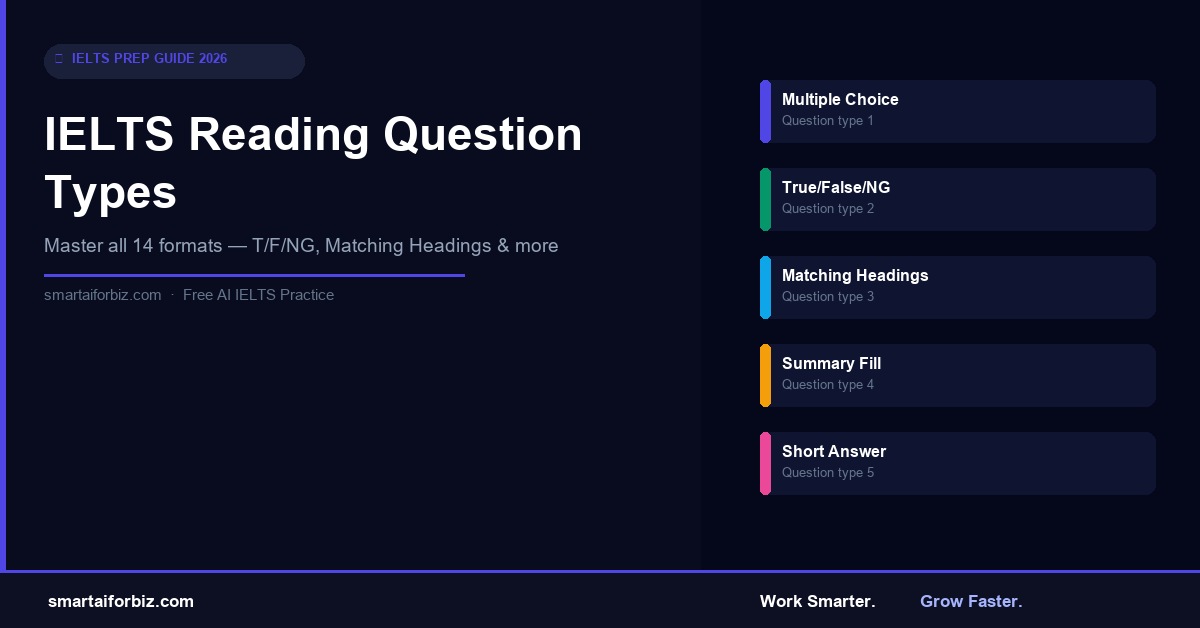
IELTS Reading Question Types: All 14 Formats Explained (2026 Guide)
The IELTS Reading question types are the single biggest factor that determines your Reading band score — not just your English level. Candidates who understand exactly what each of the 14 question formats requires consistently score 0.5–1.0 bands higher than those who rely on general reading ability alone. Our free AI IELTS practice tool includes all 14 question types with instant feedback so you can master each format before test day.
The 14 IELTS Reading Question Types (Complete List)
| Question Type | What You Do | Skill Tested |
|---|---|---|
| Multiple Choice | Choose A, B, C or D (or multiple answers) | Detailed comprehension |
| True / False / Not Given | Decide if statement matches text exactly | Fact vs opinion distinction |
| Yes / No / Not Given | Like T/F/NG but for opinions & claims | Writer’s viewpoint |
| Matching Headings | Match headings to paragraphs | Main idea identification |
| Matching Information | Find which paragraph contains info | Scanning for detail |
| Matching Features | Match features to a list of options | Specific detail location |
| Matching Sentence Endings | Complete sentences from a list | Sentence-level comprehension |
| Sentence Completion | Fill gaps using words from the text | Paraphrase recognition |
| Summary Completion | Complete a passage summary | Global comprehension |
| Note Completion | Fill a notes template | Scanning & skimming |
| Table Completion | Fill missing cells in a table | Categorisation |
| Flow Chart Completion | Complete a process diagram | Sequence understanding |
| Diagram Label Completion | Label parts of a diagram | Spatial description |
| Short Answer Questions | Answer using words from the text exactly | Precise detail location |
Practice All 14 Reading Question Types Free
Our AI tool includes all 14 IELTS Reading formats with targeted feedback on each. Know your weakest type and fix it before your exam.
✅ Instant band score
✅ No signup · Free
True / False / Not Given — The Question Type Most Candidates Get Wrong
True/False/Not Given (T/F/NG) is the most failed IELTS Reading question type. The critical rule: Not Given means the text neither confirms nor denies the statement — it is completely absent from the passage. Many candidates confuse “False” (text explicitly contradicts) with “Not Given” (text is simply silent).
| Answer | Meaning | Common Mistake |
|---|---|---|
| TRUE | Statement agrees exactly with the text | Choosing True when info is only implied |
| FALSE | Statement contradicts the text directly | Choosing False when info is just absent |
| NOT GIVEN | No information about this in the text | Choosing NG when the text actually contradicts |
Yes / No / Not Given — Different Rules from T/F/NG
Yes/No/Not Given questions test the writer’s views and claims, not factual information. Use “Yes” when the text supports the writer’s opinion, “No” when the writer disagrees, and “Not Given” when the passage doesn’t address the viewpoint at all.
Matching Headings — The Highest-Scoring Strategy
Matching Headings is won or lost in the topic sentence of each paragraph. Always read the first and last sentence before the middle. The heading reflects the main idea, not a supporting detail mentioned once.
Top strategy: Eliminate headings you’ve already used. Cross them off as you go. This limits your options and speeds up decision-making significantly.
| Question Type | Best Time Allocation | Key Strategy |
|---|---|---|
| Multiple Choice | ~2 min per question | Read questions first, then locate in text |
| T/F/NG | ~1.5 min per question | Focus on exact wording — every word counts |
| Matching Headings | ~1.5 min per paragraph | Read topic sentences only |
| Sentence/Summary Completion | ~1.5 min per gap | Paraphrase clues in the text |
| Short Answer Questions | ~1 min per question | Copy words exactly from text |
How to Practice IELTS Reading Question Types Effectively
The most effective practice method is focused drilling by type. Spend one full session on T/F/NG only. Then one session on Matching Headings only. Mixing all types in one sitting slows skill acquisition. Once you can score 80%+ on a type in isolation, mix it into full practice tests.
Practice Every Reading Question Type With AI Feedback
1,005 questions covering all 14 IELTS Reading formats. Get instant feedback showing exactly which types you’re missing and why.
✅ Instant band score
✅ No signup · Free
Frequently Asked Questions
How many questions are in the IELTS Reading section?
The IELTS Reading section contains 40 questions across 3 passages. Each question is worth 1 mark. You have 60 minutes with no extra transfer time (unlike Listening).
Do all 14 question types appear in every exam?
No. Each exam contains 4–6 question types across 3 passages. The specific types vary per paper, but T/F/NG, Multiple Choice and Matching Headings appear in most Academic tests.
Can I write more than the word limit?
No. If the question says “Write NO MORE THAN TWO WORDS,” writing three words scores zero — even if all three words are correct. Always count your words.