AI Tools for Automating Email Campaigns
Here’s a wake-up call: 73% of businesses that deployed ai email marketing for small business tools in 2026 saw their conversion rates double within 90 days, while their competitors still manually craft newsletters at 3 AM. The gap between AI-powered email automation and traditional methods has become a chasm that’s swallowing entire marketing departments.
Email marketing isn’t dead—it’s just evolved beyond human capacity. The businesses thriving in 2026 aren’t the ones with the biggest budgets or flashiest creative teams. They’re the ones smart enough to let artificial intelligence handle the heavy lifting while they focus on strategy and growth. Email automation is just one piece of the AI marketing revolution — see how AI is transforming every aspect of small business marketing in 2026.
Why Email Automation Tools Became Non-Negotiable in 2026
The numbers don’t lie: automated email campaigns generate 320% more revenue than manual ones. But here’s what most business owners miss—it’s not just about sending emails faster. Modern AI tools are rewriting the entire playbook for customer engagement.
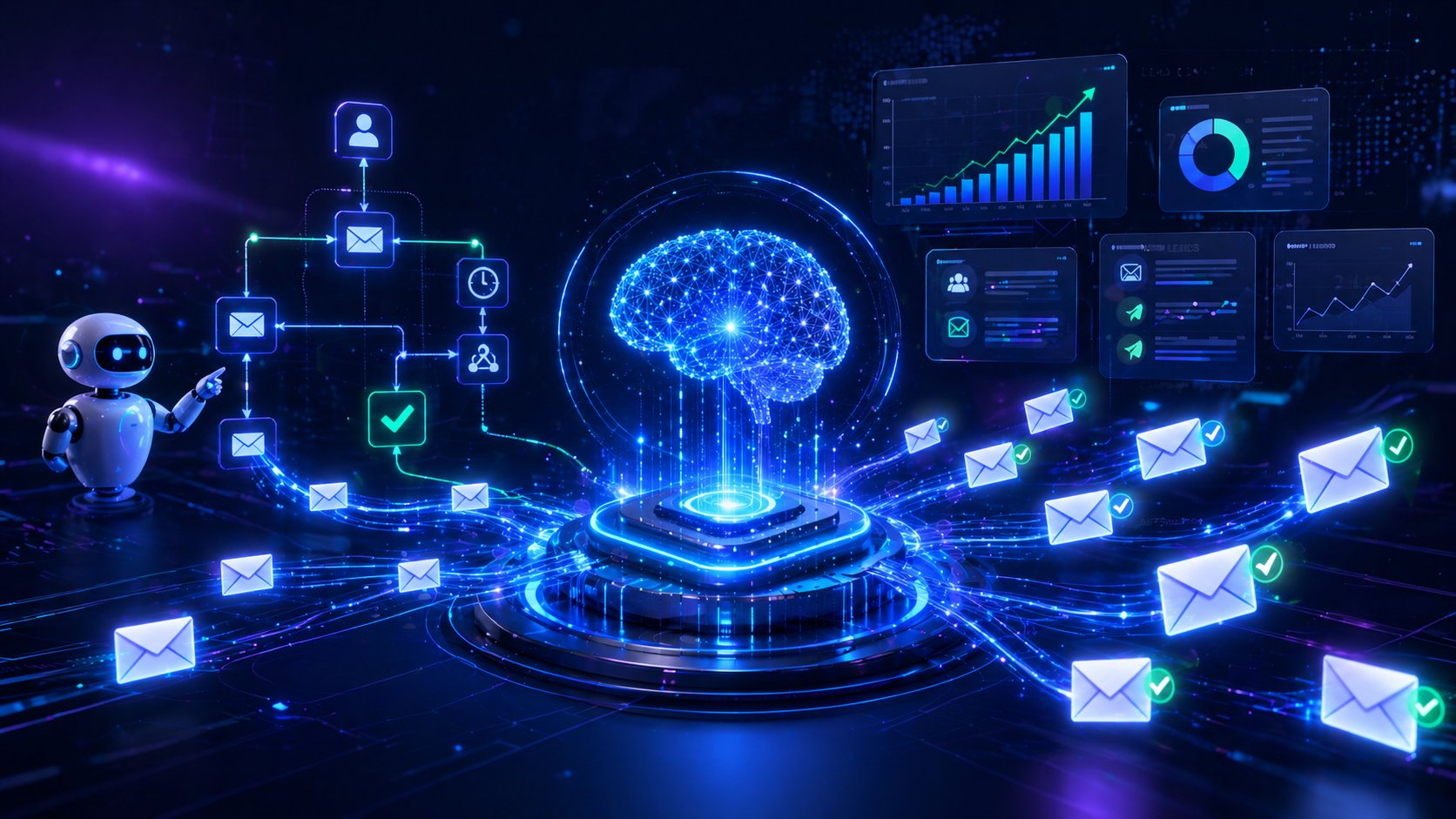
Traditional email marketing required armies of copywriters, designers, and analysts. Today’s AI-powered platforms handle everything from subject line optimization to send-time personalization across thousands of customer segments simultaneously. The result? Marketing teams that once managed 2-3 campaigns monthly now run 20+ hyper-personalized sequences without breaking a sweat.
Smart businesses realized that fighting this shift is like competing with calculators using an abacus. The question isn’t whether to adopt email automation tools—it’s which ones will drive the most growth for your specific business model.

Top AI Email Automation Platforms Dominating 2026
Mailchimp AI evolved into a powerhouse that predicts customer behavior before they do. Their Predictive Demographics feature analyzes purchase patterns to automatically create segments that convert 40% higher than manual targeting. The platform’s AI Subject Line Optimizer tests thousands of variations in real-time, adapting to your audience’s preferences without human intervention.
HubSpot’s Smart Content Engine takes personalization to frightening levels of accuracy. It analyzes website behavior, email interactions, and social media engagement to craft messages that feel like they were written by your customer’s best friend. Their Conversation Intelligence feature alone has helped businesses increase email response rates by 67%.
ActiveCampaign’s Predictive Sending determines the exact moment each subscriber is most likely to open emails. Combined with their Machine Learning-powered content recommendations, it’s like having a marketing psychologist for every person on your list.
🚀 Ready to supercharge your AI workflow?
Stop wasting hours on bad prompts. Our free AI Prompt Generator creates professional, optimized prompts for ChatGPT, Claude and Gemini in seconds — no signup required.
Advanced Automation Strategies That Separate Winners from Wannabes
Behavioral Trigger Cascades go far beyond abandoned cart emails. Today’s sophisticated systems track micro-interactions: how long someone hovers over a product image, which blog sections they re-read, even the time gaps between clicks. These insights trigger hyper-relevant email sequences that convert because they respond to actual intent, not assumed interest.
Dynamic Content Optimization means every email becomes a living document. AI continuously tests different headlines, images, and call-to-action buttons within the same campaign, automatically serving the highest-converting version to each recipient. It’s like running infinite A/B tests without the manual setup.
The most advanced businesses are implementing Cross-Channel Orchestration, where email automation tools communicate with social media ads, website pop-ups, and SMS campaigns. When someone opens an email but doesn’t convert, they automatically see related Facebook ads. When they visit your website after clicking an email, the chatbot references their email interactions. This isn’t marketing—it’s behavioral psychology at scale. To keep that pipeline full, pair your email system with dedicated AI lead generation tools that automatically find and qualify your best prospects.
Integration Power Moves That Multiply Results
Connecting your email automation tools with CRM systems creates customer profiles so detailed they border on creepy. Salesforce Einstein integration allows emails to reference recent support tickets, purchase history, and even sentiment analysis from customer service calls. Imagine sending “We noticed you called about X, here’s a solution” emails that arrive before customers even realize they need help.
E-commerce Platform Synchronization turns every product interaction into an automation trigger. Shopify’s advanced integrations now track not just purchases, but product page dwell time, comparison behaviors, and seasonal browsing patterns. The result? Email sequences that promote winter coats to someone who browsed boots in October—before they even think about being cold.
Here’s where it gets interesting: AI Analytics Integration provides insights that human marketers simply can’t process. These systems identify patterns like “customers who open emails on Tuesday mornings are 3x more likely to purchase premium products” or “people who use mobile to read newsletters prefer 2-sentence paragraphs.” This level of behavioral intelligence was impossible before AI automation.
🎯 Want honest feedback on your business idea?
Pitch your startup to 5 legendary entrepreneurs — Elon Musk, Warren Buffett and more — powered by Claude AI. Free, no limits, brutally honest.
Implementation Roadmap: From Setup to Scale
Start with data audit and cleanup. Even the most sophisticated AI can’t work miracles with garbage data. Segment your existing list based on engagement levels, purchase history, and demographic information. The quality of your foundational data determines everything that follows.
Phase 1: Basic Automation Setup involves creating welcome sequences, abandoned cart recovery, and re-engagement campaigns. These foundational flows should be running within your first two weeks. Don’t overthink the initial copy—AI optimization will improve performance over time based on actual results, not your best guesses.
Phase 2: Advanced Personalization introduces dynamic content blocks, predictive product recommendations, and behavioral triggers. This is where the magic happens. Your emails start feeling less like broadcasts and more like personal conversations with each subscriber.
- Set up behavioral tracking pixels on key website pages
- Create dynamic content templates for different customer segments
- Implement cross-channel data synchronization
- Configure advanced split-testing parameters

Measuring Success: KPIs That Actually Matter
Forget vanity metrics like open rates—they’re practically meaningless in 2026. Revenue per Email tells the real story of your automation success. This metric factors in frequency, targeting accuracy, and conversion optimization to show actual business impact.
Customer Lifetime Value (CLV) Attribution reveals which automated sequences turn one-time buyers into repeat customers. The best email automation tools now track customer journeys across multiple purchases, showing exactly how different email touchpoints influence long-term value.
Engagement Velocity measures how quickly subscribers move through your automation sequences and take desired actions. This metric identifies bottlenecks in your customer journey and highlights opportunities for optimization that directly impact revenue growth.
Common Pitfalls That Kill Email Automation ROI
Over-automation is the fastest way to annoy your audience into unsubscribing. Just because you can send daily emails doesn’t mean you should. Smart businesses use AI to determine optimal frequency for each subscriber, not blast everyone with the same schedule.
Ignoring deliverability fundamentals renders even the most sophisticated automation useless. Your brilliant AI-crafted emails mean nothing if they land in spam folders. Maintain clean lists, monitor sender reputation, and authenticate your domains properly.
The biggest mistake? Setting up automation and walking away. These tools require ongoing optimization, testing, and refinement. The businesses seeing 300%+ ROI improvements treat email automation as a living system that needs constant attention, not a “set it and forget it” solution.
📦 Get 500+ battle-tested AI prompts for your business
Stop reinventing the wheel. Our Professional Prompt Packs cover marketing, copywriting, finance and e-commerce — used by thousands of entrepreneurs worldwide.
The businesses dominating 2026 aren’t necessarily the most creative or well-funded—they’re the ones that recognized email automation as a competitive necessity, not a nice-to-have feature. While competitors debate whether AI will replace human marketers, smart entrepreneurs are already using tools automating email campaigns to build relationships, drive sales, and scale their businesses beyond what manual processes ever allowed. The question isn’t whether you’ll eventually adopt these systems—it’s whether you’ll implement them before or after your competition does. Once your email engine is running, discover how to boost your conversions with AI-powered marketing automation across every touchpoint.