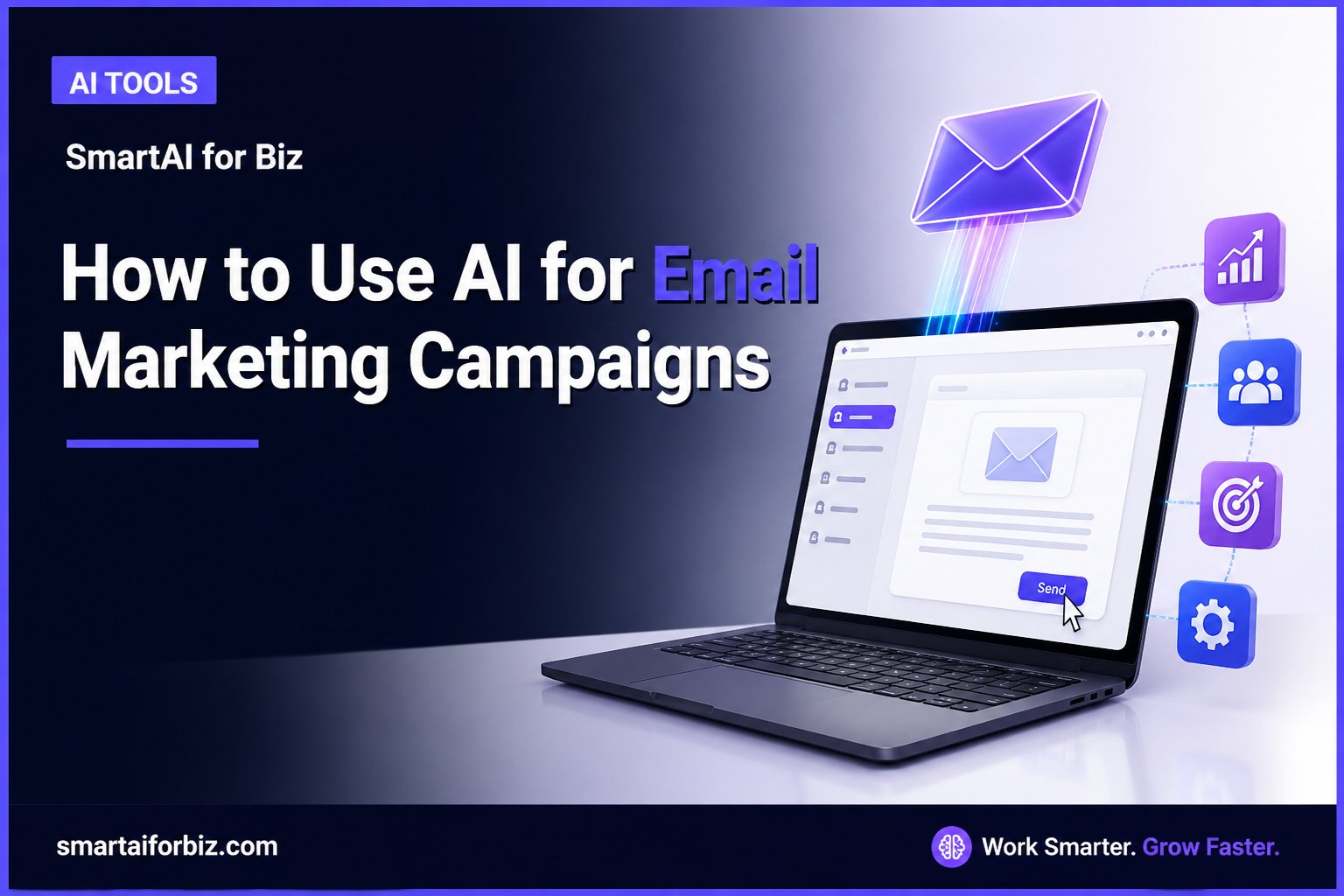
How to Use AI for Email Marketing Campaigns
Your email open rates just dropped 40% overnight, and you have no idea why. The subject line that worked last month now sends emails straight to spam folders. Your carefully crafted newsletter sits unread while competitors somehow nail the perfect timing, personalization, and content that gets clicks.
AI transforms this frustrating guesswork into predictable results. Smart email marketing campaigns now leverage machine learning to optimize send times, personalize content at scale, and predict which subscribers will convert before they even click. The technology handles the complex data analysis while you focus on strategy and growth.
Why Traditional Email Marketing Falls Short
Most businesses treat email marketing like a numbers game — blast the same message to thousands of people and hope for decent results. This spray-and-pray approach ignores individual preferences, optimal timing, and the nuanced factors that drive engagement.
Manual segmentation takes hours and often misses subtle patterns in customer behavior. You might know that Sarah from Chicago opened your last three emails, but you can’t spot the deeper connections between purchase history, browsing patterns, and engagement timing across your entire subscriber base. AI processes these complex relationships in seconds.
Traditional A/B testing also moves too slowly for today’s market. By the time you’ve tested two subject lines over a week, AI has already analyzed thousands of variables and optimized your campaigns in real-time.
Smart Subject Line Optimization with AI
Subject lines determine whether your email gets opened or ignored, yet most marketers rely on gut instinct rather than data-driven optimization. AI analyzes your audience’s historical engagement patterns, current trends, and linguistic preferences to craft compelling subject lines.
Tools like Phrasee and Persado use natural language generation to create multiple subject line variations, then predict performance before you hit send. These platforms learn from your specific audience rather than generic best practices that might not apply to your industry or customer base.
The key is training AI on your actual email performance data. Feed it your top-performing subject lines from the past year, along with engagement metrics, and it will identify the specific words, emotions, and structures that resonate with your subscribers. This creates a feedback loop that continuously improves your open rates.
🚀 Ready to supercharge your AI workflow?
Stop wasting hours on bad prompts. Our free AI Prompt Generator creates professional, optimized prompts for ChatGPT, Claude and Gemini in seconds — no signup required.
Personalization That Actually Converts
Adding someone’s first name to an email isn’t personalization — it’s basic mail merge from the 1990s. Real personalization means delivering content that matches individual interests, purchase timing, and behavioral patterns.
AI-powered platforms like Mailchimp’s Customer Journey Builder and Klaviyo’s Smart Recommendations analyze dozens of data points to create unique experiences for each subscriber. They consider browsing history, past purchases, email engagement patterns, and even seasonal buying trends to determine what content will drive action.
Dynamic content insertion takes this further by automatically swapping product recommendations, offers, and messaging based on real-time data. Your fashion e-commerce newsletter might show winter coats to subscribers in cold climates while displaying summer dresses to those in warmer regions — all from a single email template.
Predictive Send Time Optimization
Timing can make or break email performance, but manually scheduling sends based on general “best practices” ignores your audience’s unique patterns. AI analyzes individual engagement history to predict when each subscriber is most likely to open and act on your emails.
Platforms like Campaign Monitor and ConvertKit use machine learning to identify personal engagement windows. Some subscribers consistently open emails during their morning commute, while others engage during lunch breaks or evening browsing sessions. AI captures these micro-patterns and schedules delivery accordingly.
The technology also factors in external variables like holidays, industry events, and seasonal trends. Your B2B newsletter might perform better on Tuesday mornings, except during conference season when Friday afternoons generate higher engagement. AI adapts to these nuanced timing shifts automatically.
🎯 Want honest feedback on your business idea?
Pitch your startup to 5 legendary entrepreneurs — Elon Musk, Warren Buffett and more — powered by Claude AI. Free, no limits, brutally honest.
Advanced Audience Segmentation Through Machine Learning
Manual segmentation typically focuses on obvious demographics like age, location, or purchase history. AI discovers hidden audience segments based on behavioral patterns that humans miss entirely.
Machine learning algorithms identify clusters of subscribers who share subtle characteristics — perhaps they all engage with emails featuring certain colors, respond to specific emotional triggers, or show similar browsing patterns before making purchases. These “lookalike segments” often outperform traditional demographic groups.
Platforms like Seventh Sense and Mailchimp’s Advanced Segmentation use clustering algorithms to automatically group subscribers based on engagement patterns, content preferences, and conversion likelihood. You might discover that your highest-value customers all share an unexpected combination of behaviors that traditional segmentation would never identify.
Content Generation and Optimization
Creating fresh email content consistently challenges even experienced marketers. AI writing assistants now generate everything from promotional copy to newsletter content, while maintaining your brand voice and optimizing for engagement.
Tools like Copy.ai and Jasper analyze your existing high-performing emails to understand your brand voice, then generate new content variations. They can create product descriptions, promotional copy, and even complete newsletter layouts based on your specifications and performance goals.
AI also optimizes content structure by analyzing which email formats drive the most engagement with your specific audience. Some segments might prefer short, scannable bullet points while others engage better with longer storytelling formats. The technology identifies these preferences and adjusts content accordingly.
Implementing AI-Driven A/B Testing
Traditional A/B testing limits you to comparing two versions over a set timeframe. AI-powered multivariate testing evaluates dozens of variables simultaneously — subject lines, send times, content variations, and call-to-action placement — then automatically implements the winning combinations.
This approach accelerates learning and optimization while reducing the statistical significance requirements that slow down traditional testing. Instead of waiting weeks for conclusive results, AI identifies winning patterns within days and applies them to future campaigns.
Automated Campaign Workflows and Triggers
Smart automation goes beyond basic drip campaigns to create complex, branching workflows that respond to subscriber behavior in real-time. AI-powered platforms build decision trees that route subscribers through personalized journeys based on their actions and characteristics.
These workflows adapt dynamically as subscribers engage. Someone who opens but doesn’t click might receive a different follow-up sequence than someone who clicks but doesn’t purchase. AI continuously optimizes these paths based on conversion data and engagement patterns.
Trigger-based campaigns can also incorporate external data sources. Your SaaS welcome series might adjust based on the subscriber’s company size, industry, or feature usage patterns. E-commerce workflows could factor in seasonal trends, inventory levels, or competitor pricing to optimize timing and offers.
Performance Analytics and Predictive Insights
AI transforms email analytics from historical reporting to predictive intelligence. Instead of simply showing what happened last month, machine learning models forecast future performance and identify optimization opportunities before they become problems.
Predictive analytics can identify subscribers at risk of churning, predict which content topics will resonate next quarter, or forecast seasonal engagement trends. This intelligence lets you adjust strategies proactively rather than reactively responding to declining metrics.
Advanced platforms also provide prescriptive recommendations. They don’t just identify that open rates are declining — they suggest specific actions like adjusting send frequency, updating subject line formulas, or refining audience segments to reverse the trend.
Integration with CRM and Sales Data
The most powerful AI email marketing happens when platforms connect with your complete customer data ecosystem. Integration with CRM systems, sales tools, and customer service platforms creates a comprehensive view of each subscriber’s journey.
This holistic data enables sophisticated triggering and personalization. Your email platform knows when a lead has a sales call scheduled, when a customer submits a support ticket, or when someone visits your pricing page multiple times. AI uses these signals to deliver perfectly timed, contextually relevant messages.
Sales and marketing alignment improves dramatically when AI identifies the email touchpoints that correlate with closed deals. You might discover that customers who engage with specific email content are 3x more likely to convert, enabling better lead scoring and sales prioritization.
Implementation Strategy for AI-Powered Email Marketing
Successfully implementing AI email marketing requires a strategic approach rather than randomly adopting new tools. Start by auditing your current performance and identifying the biggest optimization opportunities.
Begin with one AI capability — perhaps send time optimization or subject line generation — and measure results before expanding. This focused approach lets you understand each technology’s impact and build internal expertise gradually.
Consider these implementation priorities:
- Data preparation: Clean and organize subscriber data to ensure AI tools have quality inputs
- Platform integration: Choose AI tools that work with your existing email platform and CRM
- Team training: Ensure your marketing team understands how to interpret AI insights and recommendations
- Performance benchmarking: Establish baseline metrics before implementing AI to measure improvement accurately
Choosing the Right AI Email Marketing Tools
The email marketing technology landscape includes everything from basic automation tools to sophisticated AI platforms. Select solutions based on your specific needs rather than the most advanced features available.
Consider your current email volume, technical resources, and primary optimization goals. Small businesses might benefit most from AI-powered subject line optimization and send time personalization, while enterprise companies could leverage advanced predictive analytics and cross-channel orchestration.
Evaluate integration capabilities carefully. The best AI email tool is useless if it can’t connect with your existing marketing stack or requires complete platform migration.
📦 Get 500+ battle-tested AI prompts for your business
Stop reinventing the wheel. Our Professional Prompt Packs cover marketing, copywriting, finance and e-commerce — used by thousands of entrepreneurs worldwide.
AI transforms email marketing from guesswork into predictable, data-driven growth. The technology handles complex optimization tasks that would take marketing teams weeks to complete manually, while continuously learning and improving performance. Smart email marketing campaigns in 2026 leverage these AI capabilities to deliver personalized experiences that drive measurable business results — turning your email list into your most profitable marketing channel.