IELTS True False Not Given: The Complete Decision Framework (2026)
IELTS True False Not Given questions are the question type that candidates find most confusing — and most costly when they get them wrong. The difference between FALSE and NOT GIVEN is entirely logical, but under exam pressure most candidates guess rather than apply the correct rule. This guide gives you the exact decision framework, worked examples from real-style passages, and 10 practice statements so you can master T/F/NG before your test. Practice with immediate feedback at our free AI IELTS Reading practice tool.
The Core Rule: TRUE vs FALSE vs NOT GIVEN
| Answer | When to Choose It | The Test |
|---|---|---|
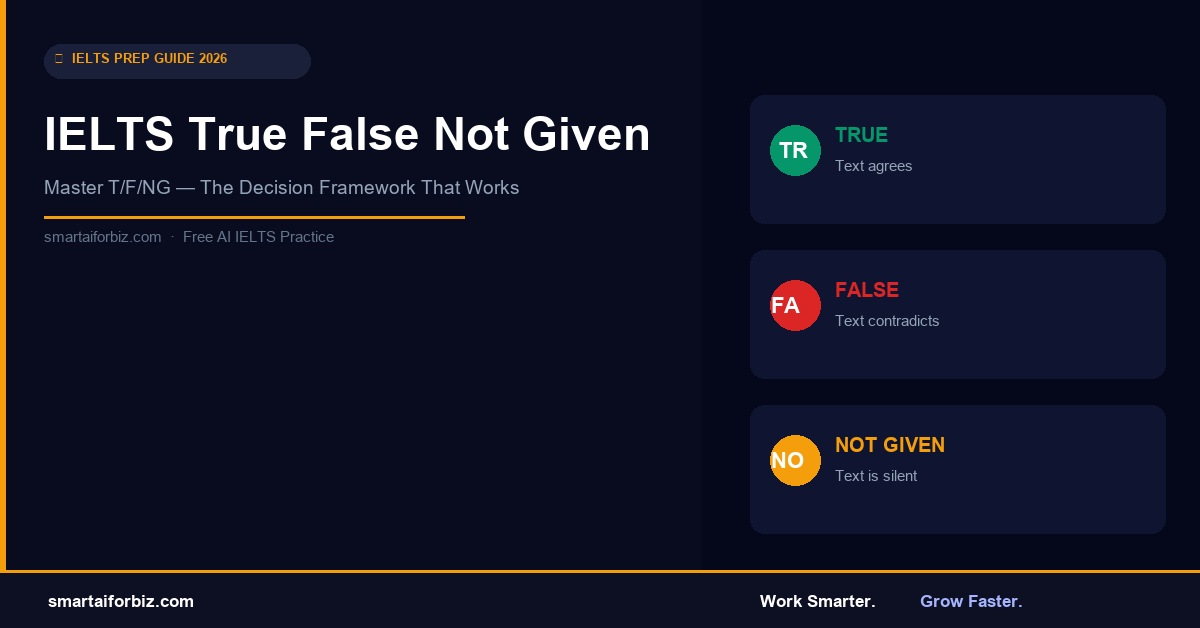
| TRUE | The statement agrees with information in the text | The text explicitly confirms this statement is correct |
| FALSE | The text directly contradicts the statement | The text explicitly says the opposite |
| NOT GIVEN | The text does not mention this at all | You cannot find any information related to this statement |
The critical distinction: FALSE requires explicit contradiction. NOT GIVEN simply means the topic is absent from the passage. Many candidates choose FALSE when the answer is actually NOT GIVEN — because the statement sounds wrong, not because the text contradicts it.
Practice T/F/NG With Instant AI Feedback
Our tool includes dedicated True/False/Not Given practice with explanations for every answer. Identify exactly why you’re confusing FALSE and NOT GIVEN.
✅ Instant band score
✅ No signup · Free
The Decision Framework: 4 Questions to Ask Yourself
- Locate: Can I find information about this topic in the passage?
- If NO → NOT GIVEN. The passage says nothing about this.
- If YES → Compare: Does the passage say the SAME thing as the statement?
- If SAME → TRUE. If OPPOSITE → FALSE.
The mistake most candidates make: they skip step 1 (locating) and go straight to comparison. If you cannot locate the relevant section of the text, the answer is almost always NOT GIVEN.
10 Common T/F/NG Traps (And How to Avoid Them)
| Trap | Example | Correct Answer & Why |
|---|---|---|
| Partial match | Statement: “All researchers agreed.” Text: “Most researchers agreed.” | FALSE — “most” explicitly contradicts “all” |
| Comparison trap | Statement: “Country A produces more than Country B.” Text: only mentions Country A’s output. | NOT GIVEN — Country B is not mentioned |
| Extreme language | Statement: “The method is always effective.” Text: “The method is usually effective.” | FALSE — “always” contradicts “usually” |
| Implied information | Statement: “The author recommends this approach.” Text: describes benefits without recommending. | NOT GIVEN — recommendation is not stated |
| Synonyms that change meaning | Statement: “Scientists proved X.” Text: “Scientists suggested X.” | FALSE — “proved” contradicts “suggested” |
YES / NO / NOT GIVEN vs TRUE / FALSE / NOT GIVEN
These question types follow the same logic but apply to different content:
| Question Type | What It Tests | Key Distinction |
|---|---|---|
| TRUE / FALSE / NOT GIVEN | Factual information from the text | Objective facts — does the text state this fact? |
| YES / NO / NOT GIVEN | The writer’s views, claims and opinions | Subjective views — does the writer express this opinion? |
Common mistake: Treating Yes/No/NG questions as factual when they are about opinion. The statement “The author believes technology will solve climate change” is a Yes/No/NG question — check what the author believes, not what the text states as fact.
IELTS T/F/NG: Practice with a Sample Passage
Passage extract: “The pace of urban migration in Southeast Asia has accelerated considerably since 2010. Governments in the region have struggled to provide adequate housing, though some cities have introduced innovative mixed-use development programmes. Environmental groups have raised concerns about the loss of agricultural land, but no formal impact assessments have been mandated by national governments.”
| Statement | Answer | Explanation |
|---|---|---|
| Urban migration in Southeast Asia has increased since 2010. | TRUE | The text says “accelerated considerably since 2010” — same meaning |
| All governments have successfully housed new urban residents. | FALSE | “struggled to provide adequate housing” explicitly contradicts “successfully housed” |
| Mixed-use development has been proven to reduce homelessness. | NOT GIVEN | No evidence about homelessness outcomes is provided |
| National governments have not required environmental impact assessments. | TRUE | “no formal impact assessments have been mandated” = TRUE |
| Environmental groups support the mixed-use development programmes. | NOT GIVEN | The text does not state their view on this — only their concern about agricultural land |
Master T/F/NG Before Your Exam
Hundreds of True/False/Not Given questions with instant AI explanations. See exactly why each answer is TRUE, FALSE or NOT GIVEN — build the habit before test day.
✅ Instant band score
✅ No signup · Free
Frequently Asked Questions
Is NOT GIVEN the most common answer?
No. In most IELTS papers, TRUE, FALSE and NOT GIVEN appear in roughly equal proportions. However, if you are unsure between FALSE and NOT GIVEN, statistically NOT GIVEN is slightly more common — which aligns with the logical rule: explicit contradiction is rarer than absence of information.
Should I read the passage or the questions first?
For T/F/NG questions, read the statements first. This tells you what information to look for in the passage. Then scan the passage for the topic of each statement and apply the decision framework.
Can I change my answer if I change my mind?
Yes — there is no penalty for changing answers in IELTS. If you change your mind, cross out your original answer cleanly and write the new answer clearly. On the computer-delivered test, simply select your new choice.