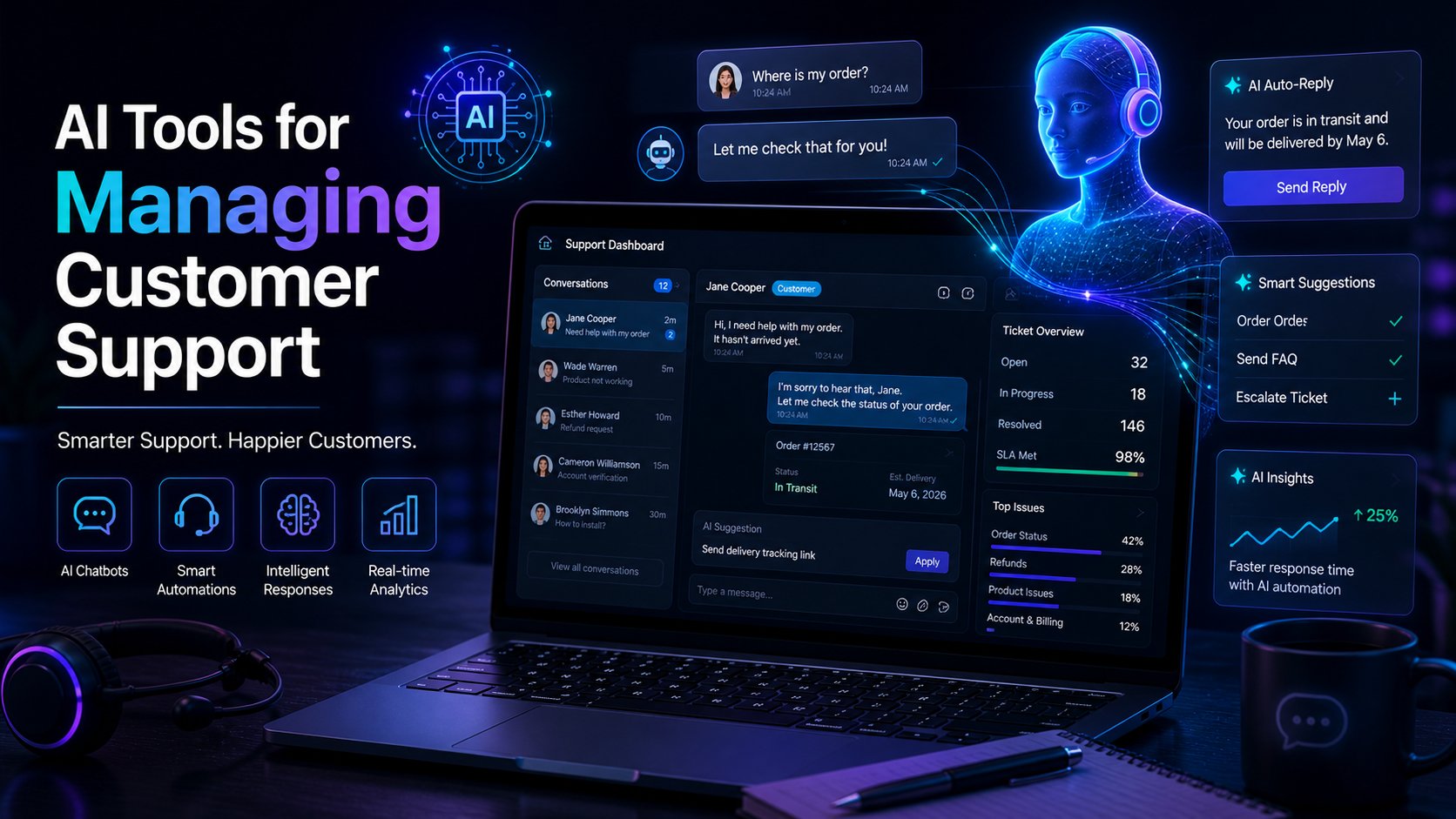
AI Tools for Managing Customer Support
Here’s a reality check: 73% of companies using AI for customer support are handling 40% more inquiries with the same team size. While your competitors scramble to hire more support agents, smart businesses are deploying sophisticated tools managing customer interactions through artificial intelligence — and they’re leaving manual processes in the dust.
The customer support landscape has fundamentally shifted in 2026. Traditional ticketing systems and endless email chains are relics of a bygone era. Today’s winning businesses leverage AI-powered platforms that don’t just respond to customers — they predict needs, resolve issues before they escalate, and transform support from a cost center into a competitive advantage.
If you’re still relying on human agents to handle every customer interaction, you’re burning cash and frustrating customers. The companies crushing it right now have embraced AI tools that work 24/7, never get tired, and learn from every single interaction.
The AI Customer Support Revolution: Why Traditional Methods Are Dead
Customer expectations have exploded beyond what human teams can realistically deliver. People want instant responses, personalized solutions, and seamless experiences across every channel. Meanwhile, support costs are skyrocketing and agent burnout is at an all-time high.
AI customer support tools solve this equation by handling routine inquiries automatically while empowering human agents to focus on complex, high-value interactions. The result? Faster resolution times, lower costs, and customers who actually enjoy their support experience.
The smartest businesses aren’t just implementing one AI tool — they’re building integrated ecosystems that work together seamlessly. Think chatbots that escalate to sentiment-aware routing systems, which then provide agents with AI-generated response suggestions based on the customer’s history and emotional state.

Essential AI-Powered Customer Support Categories
Not all AI support tools are created equal. The market has evolved into distinct categories, each solving specific problems in your support workflow. Understanding these categories helps you build a comprehensive AI support strategy rather than cobbling together random tools.
Conversational AI and Chatbots handle the heavy lifting of initial customer contact. Modern AI chatbots don’t just follow decision trees — they understand context, maintain conversation flow, and can handle complex multi-turn dialogues that would have stumped earlier generations of automation.
Intelligent Ticket Routing and Management systems analyze incoming requests using natural language processing to automatically categorize, prioritize, and route tickets to the most qualified agents. These tools eliminate the bottleneck of manual ticket assignment while ensuring customers reach the right expert immediately.
- Real-time sentiment analysis to flag frustrated customers for priority handling
- Automatic language detection and routing to multilingual support teams
- Integration with CRM systems for complete customer context
- Predictive analytics to anticipate ticket volume and staffing needs
🚀 Ready to supercharge your AI workflow?
Stop wasting hours on bad prompts. Our free AI Prompt Generator creates professional, optimized prompts for ChatGPT, Claude and Gemini in seconds — no signup required.
Top AI Customer Support Platforms Dominating 2026
Zendesk Answer Bot has evolved into a sophisticated AI assistant that integrates deeply with your existing help center. It doesn’t just search for articles — it understands customer intent and provides contextual answers while learning from every interaction to improve accuracy over time.
The platform excels at deflecting routine tickets before they reach human agents. Its machine learning algorithms analyze your historical ticket data to identify patterns and proactively surface solutions. For businesses handling thousands of repetitive inquiries, Answer Bot can reduce ticket volume by up to 60%.
Intercom Resolution Bot takes a conversation-first approach to customer support automation. Instead of traditional forms and ticket numbers, customers engage in natural conversations that feel genuinely helpful rather than robotic.
What sets Intercom apart is its ability to blend AI automation with human handoff seamlessly. When the bot reaches its limits, the transition to human agents includes full conversation context, eliminating the frustrating “let me start over” experience that plagues traditional support channels.
Freshworks Freddy AI positions itself as an intelligent support co-pilot rather than a replacement for human agents. Freddy analyzes customer conversations in real-time and suggests responses, identifies upsell opportunities, and flags potential escalations before they become problems.

Advanced AI Features That Separate Leaders from Followers
The basic AI support tools handle simple FAQ responses — that’s table stakes in 2026. The platforms that deliver real competitive advantage offer sophisticated features that transform how your entire support operation functions.
Predictive Issue Resolution analyzes patterns across your customer base to identify potential problems before customers even report them. Imagine sending proactive notifications about service issues or automatically processing refunds for delayed shipments before customers complain.
Emotion AI and Sentiment Analysis goes beyond keyword detection to understand customer emotional state throughout interactions. These systems automatically escalate frustrated customers to senior agents while identifying opportunities to turn neutral experiences into positive ones through personalized responses.
Multilingual Support with Cultural Context handles global customer bases with AI that understands not just language differences, but cultural communication styles. The technology adapts response tone and structure based on regional preferences while maintaining brand consistency.
- Voice AI Integration: Handle phone support with natural language processing that rivals human agents
- Visual Recognition: Process screenshots and images to understand technical issues automatically
- Behavioral Analytics: Track customer journey patterns to provide contextual support based on user actions
🎯 Want honest feedback on your business idea?
Pitch your startup to 5 legendary entrepreneurs — Elon Musk, Warren Buffett and more — powered by Claude AI. Free, no limits, brutally honest.
Implementation Strategy: Building Your AI Support Stack
Rolling out AI customer support isn’t a flip-the-switch operation. Successful implementations follow a strategic approach that gradually introduces automation while maintaining service quality and team buy-in.
Start with low-risk, high-volume interactions like password resets, order status inquiries, and basic product questions. These interactions follow predictable patterns and have clear success metrics, making them ideal testing grounds for your AI implementation.
Design your AI tools to enhance human agents rather than replace them. The most successful deployments use AI to handle routine tasks while providing agents with intelligent suggestions, customer context, and escalation triggers that make them more effective at complex problem-solving.
Establish clear escalation protocols and feedback loops. Your AI should know when to hand off to humans, and your human agents should be able to flag AI responses that need improvement. This continuous learning cycle is what separates successful AI implementations from frustrating customer experiences.
Measuring Success: KPIs That Actually Matter
Traditional support metrics like average handle time miss the bigger picture when evaluating AI customer support effectiveness. The real value comes from improvements in customer experience, agent efficiency, and business outcomes.
First Contact Resolution Rate measures how often customer issues are completely resolved in the initial interaction, whether with AI or human agents. This metric directly correlates with customer satisfaction and support cost efficiency.
AI Deflection Rate tracks the percentage of inquiries successfully handled by AI without human intervention. However, this metric only matters if deflected customers are actually satisfied with their experience — monitor satisfaction scores for AI-only interactions separately.
- Customer Effort Score (CES) for AI interactions versus human-handled tickets
- Agent productivity metrics including tickets resolved per hour and customer satisfaction scores
- Cost per resolution comparing AI-handled versus human-handled inquiries
Common Pitfalls and How to Avoid Them
The graveyard of failed AI support implementations is littered with companies that focused on technology over customer experience. Learning from these failures helps you avoid expensive mistakes and frustrated customers.
Over-automation is the most common mistake. Companies get excited about AI capabilities and try to automate everything, creating robotic experiences that frustrate customers. The goal isn’t to eliminate human interaction — it’s to make every interaction more valuable.
Poor training data leads to AI that sounds confident while providing incorrect information. Your AI is only as good as the data you feed it. Invest time in cleaning your knowledge base and establishing clear processes for updating AI training when policies or products change.
Ignoring edge cases creates support gaps that leave customers stranded. Your AI might handle 80% of inquiries perfectly, but the 20% it can’t handle need clear, fast pathways to human assistance.
📦 Get 500+ battle-tested AI prompts for your business
Stop reinventing the wheel. Our Professional Prompt Packs cover marketing, copywriting, finance and e-commerce — used by thousands of entrepreneurs worldwide.
The businesses winning in 2026 aren’t just using AI — they’re thinking strategically about how intelligent automation fits into their broader customer experience strategy. The right combination of tools managing customer interactions through AI doesn’t just cut costs; it creates competitive advantages that are difficult for slower-moving competitors to replicate. Start with one tool, measure ruthlessly, and scale what works. Your customers — and your bottom line — will thank you.