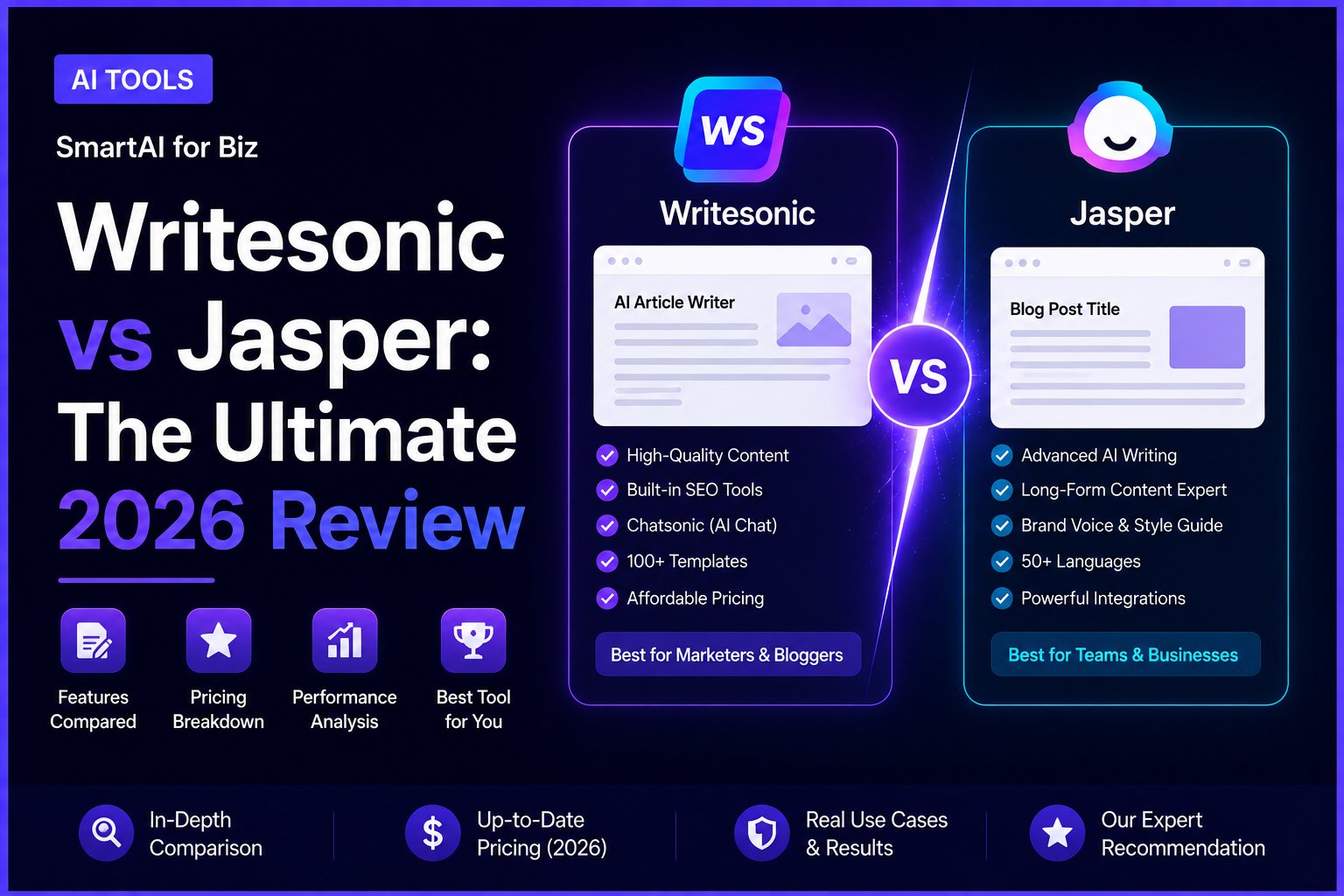
Writesonic vs Jasper : Which AI Writing Tool Is Actually Worth It?
Choosing between Writesonic and Jasper comes down to one question: do you want speed and volume at a low price, or premium, on-brand output you barely need to edit? This honest 2026 comparison breaks down pricing, output quality, features and real use-cases so you can pick the right AI writing tool for your business the first time.
⚡ TL;DR — The 30-second verdict
Pick Writesonic if you need high content volume, social/ad copy and the lowest price. Best for solopreneurs, marketers and lean startups.
Pick Jasper if brand voice, long-form quality and team collaboration matter more than price. Best for agencies and established businesses.
Writesonic vs Jasper: Side-by-Side Comparison
| Criteria | Writesonic | Jasper |
|---|---|---|
| Starting price (2026)* | ~$16/mo | ~$39–49/mo |
| Best for | Volume & ad copy | Long-form & brand voice |
| Free trial | Yes | 7-day |
| Templates | 100+ | 50+ (curated) |
| Brand voice training | Basic | Advanced |
| Built-in chatbot | Chatsonic | Jasper Chat |
| Team collaboration | Limited | Strong |
*Pricing changes often — always confirm the current plan on the official site before buying.
Features: What Each Tool Does Best
Writesonic is the “Swiss Army knife” — a modern, template-heavy platform built for churning out marketing copy fast. Jasper focuses on premium, on-brand content with sophisticated brand-voice controls that make it feel like working with a trained copywriter.
Writesonic strengths:
- 100+ templates for ads, blogs, emails and social posts
- Chatsonic — a ChatGPT-style assistant with web data
- Bulk generation for scaling content
- Built-in SEO and paraphrasing tools
Jasper strengths:
- Advanced brand voice & tone customization
- Superior long-form coherence (fewer edits)
- Team workspaces, roles and collaboration
- Robust integrations (Zapier, API, Chrome)
🚀 Before you pay for any AI writer…
Better prompts = better output from any tool. Our free AI Prompt Generator builds optimized prompts for ChatGPT, Claude and Gemini in seconds — no signup.
Pricing: Which Gives You More Value?
Writesonic wins on entry price, starting around $16/month and scaling by word volume — ideal if you publish a lot and watch your budget. Jasper starts higher (roughly $39–49/month) but many users find its output needs less editing, which can save time overall. If cost-per-word is your priority, Writesonic leads; if editing time and brand consistency matter more, Jasper often justifies the premium.
Content Quality: The Real Difference
Writesonic is excellent for fast first drafts, short-form copy and social/ad content, though longer pieces can need cleanup. Jasper tends to hold brand voice and coherence better across long-form articles, which is why agencies lean toward it. Neither replaces a human editor — but both dramatically speed up the first 80% of the work.
Which One Should You Choose?
Choose Writesonic if you…
publish high volume, need ad/social copy, want the lowest price, or run a lean solo/startup operation.
Choose Jasper if you…
produce long-form content, need strict brand voice, work in a team, or run an agency where quality beats cost.
🎯 Want honest feedback on your business idea first?
Pitch your startup to 5 legendary entrepreneurs — powered by Claude AI. Free, no limits, brutally honest.
Frequently Asked Questions
Is Writesonic or Jasper better for beginners?
Writesonic is easier to start with thanks to its lower price and template library. Jasper has a steeper learning curve but rewards you with more control.
Which is cheaper, Writesonic or Jasper?
Writesonic is cheaper, starting around $16/month versus Jasper’s ~$39–49/month.
Can I try both for free?
Yes — both offer free trials, so you can test output on your own content before committing.
Which produces higher-quality long-form content?
Jasper generally edges ahead on long-form coherence and brand voice; Writesonic shines on speed and short-form copy.
Final Verdict
There’s no single winner — only the right fit for your workflow. For volume, affordability and marketing copy, Writesonic is the smart pick. For premium, on-brand long-form content and team work, Jasper earns its higher price. Try both free, run the same brief through each, and let the output decide.
New to AI tools? Start with our best AI tools for 2026 guide, or see the 10 AI tools every entrepreneur needs.