
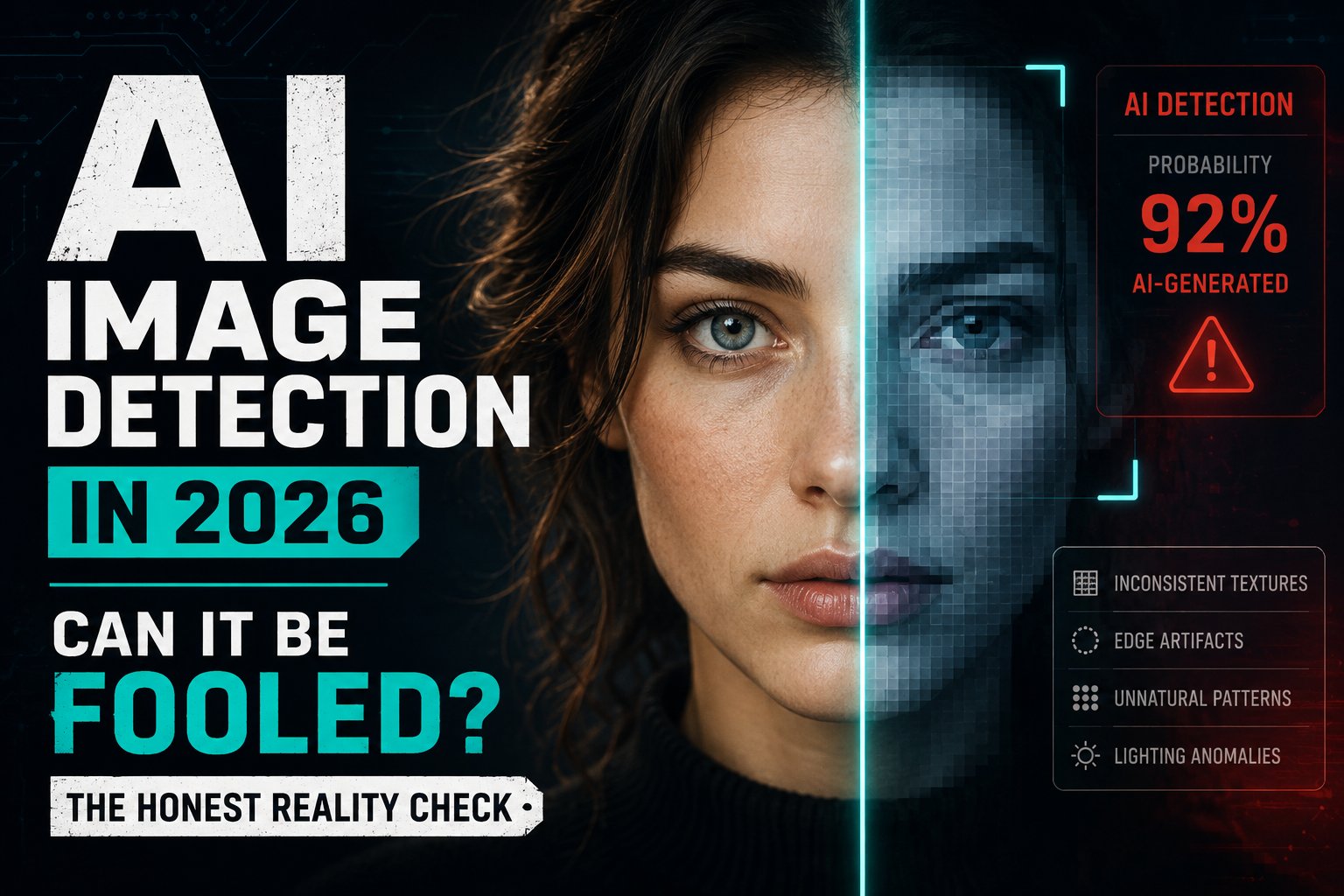
AI Image Detection in 2026: Can It Be Fooled? The Honest Reality Check
AI image detectors are arms-racing against AI image generators. In 2026, both sides have become significantly more capable — and the gap between them is closing in ways that matter for publishers, businesses, and anyone who works with digital images professionally.
Here is an honest assessment of where detection stands, what can and cannot be detected, and what that means for you.
How AI Image Detectors Work
AI image detectors use two primary approaches:
1. Statistical Pattern Analysis
AI-generated images have subtle statistical fingerprints — patterns in pixel distributions, frequency domain characteristics, and spatial correlations that differ from photographs taken by cameras. Tools like Hive Moderation and AI or Not primarily use this approach.
2. Metadata Analysis
Reading C2PA credentials, EXIF software fields, and XMP generation parameters. This is essentially reading the label the AI tool attached to the image. Highly reliable — but only if the metadata has not been removed.
What Detectors Can Reliably Catch in 2026
- Images with intact C2PA credentials — near-100% accuracy
- Unprocessed outputs from major generators (DALL-E, Firefly, Midjourney) — 85-95% accuracy
- SynthID-watermarked images — highly reliable for Google Imagen outputs
- Low-resolution or compressed AI images — easier to detect due to compression artefacts interacting with AI patterns
What Detectors Struggle With
- Images that have been post-processed — resizing, colour grading, noise addition, or JPEG re-compression can significantly reduce detector accuracy
- Metadata-stripped images — removing EXIF, XMP, and C2PA forces detectors to rely on statistical patterns alone
- AI-composited images — where AI-generated elements are blended with real photography
- Fine-tuned or distilled models — smaller, locally-run models like certain Stable Diffusion variants may not match the fingerprints detectors are trained on
- Photorealistic portrait generators — top-tier generators now produce faces that fool human reviewers and automated detectors at similar rates
The Metadata Removal Question
Removing AI metadata does not make an image “undetectable” — it removes the most reliable signal and forces detectors to rely on statistical methods that are less accurate.
Why would someone legitimately remove AI metadata?
- A designer who wants their AI-generated concept art to be evaluated on merit, not origin
- A photographer whose real photos are being incorrectly tagged as AI-generated by automated systems
- A marketer preparing assets for platforms that automatically flag or reject AI-labelled content
- Privacy — not wanting to reveal which tools are in their workflow
If any of these apply to you, our free metadata removal tool handles C2PA, EXIF, and XMP stripping in seconds.
The False Positive Problem
One of the most significant issues in 2026 is false positives — real photographs being flagged as AI-generated. This happens because:
- Some camera software creates EXIF patterns similar to AI tools
- Heavy photo editing (smooth skin retouching, sky replacement) creates statistical patterns that resemble AI outputs
- Stock photo compression pipelines alter the statistical fingerprints detectors rely on
Several professional photographers have reported their unedited work being rejected by platforms due to false AI detection. If this has happened to you, removing and re-adding clean, human-origin metadata can sometimes resolve the issue.
The Bottom Line
AI image detection in 2026 is reliable for images with intact metadata and unprocessed AI outputs. It becomes significantly less reliable once images are processed, edited, or metadata-stripped. No single detector is definitive — the most reliable approach combines metadata analysis, statistical detection, and human review for high-stakes decisions.
Remove AI Metadata from Your Images
Free, browser-based, no upload required. Strips C2PA, EXIF, XMP, and IPTC metadata completely.