IELTS Writing Task 1 Academic: Complete 2026 Guide + Free AI Practice
IELTS Writing Task 1 Academic is where many candidates lose easy marks. Unlike Task 2, it is not an opinion essay — it is a precise, objective description of visual data. And yet, the same structural mistakes appear again and again in Band 5 and Band 6 scripts.
This complete guide covers everything you need to score Band 7+ on Academic Writing Task 1 in 2026 — from graph types and structure to vocabulary, common mistakes, and how to use free AI feedback to accelerate your preparation.
What Is IELTS Writing Task 1 Academic?
In Writing Task 1 Academic, you are given one or more visual data sources — a graph, chart, table, map or diagram — and asked to summarise the key information and make comparisons where relevant. You have 20 minutes and must write at least 150 words.
Key requirements:
- Minimum 150 words (aim for 170–190)
- Time allocation: 20 minutes
- Worth one third the marks of Task 2 — but still important for your overall Writing band
- You must describe, not interpret — do not give your opinion
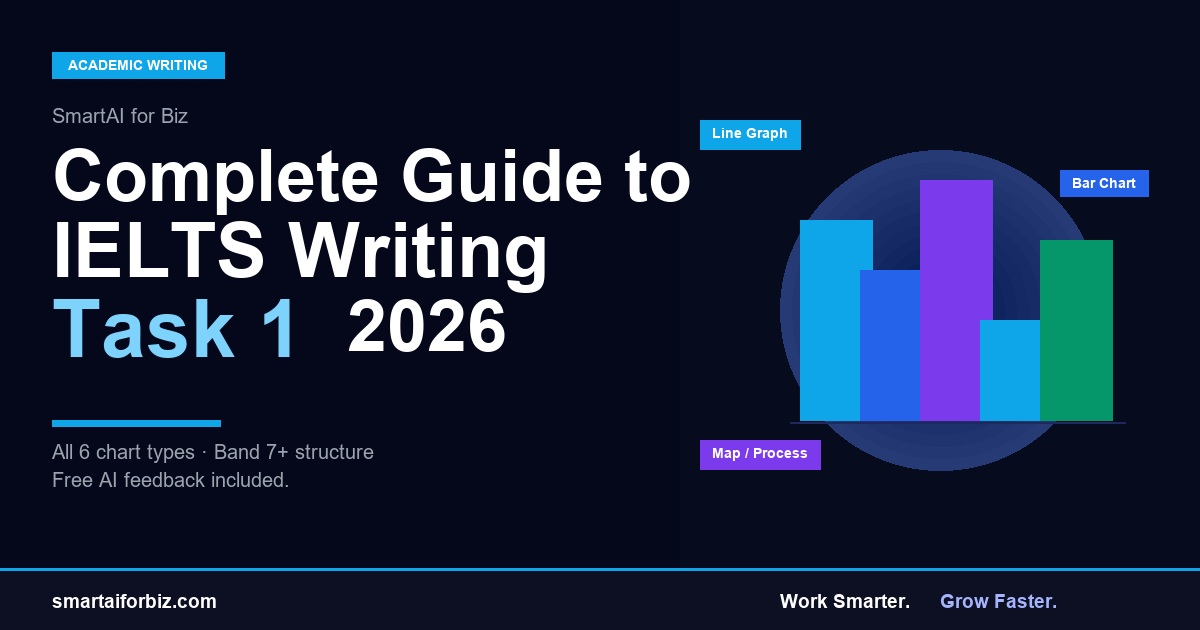
The 6 Types of Academic Writing Task 1
Each task type requires a slightly different approach. Misidentifying your task type leads to structural errors that cost marks.
1. Line Graph
Shows trends over time. Focus on overall trend direction, peaks and troughs, and comparisons between lines. Use language of change: rose sharply, fell gradually, remained stable, fluctuated.
2. Bar Chart
Compares categories or time periods. Identify the highest, lowest, and most notable comparisons. You don’t need to describe every bar — select the most significant data points.
3. Pie Chart
Shows proportions. Focus on the largest and smallest segments and any roughly equal categories. Often combined with a second pie chart for comparison — look for what changed between the two.
4. Table
Contains multiple data sets. Do not describe every figure — identify patterns, extremes, and notable exceptions. Group similar data together rather than going row by row.
5. Map
Shows geographical or layout changes (present vs past, or before vs after development). Focus on what has changed, what has stayed the same, and new features added. Use location language: to the north of, adjacent to, in the eastern corner.
6. Process Diagram
Describes a manufacturing process, natural cycle, or sequence of stages. Always describe stages in order using sequencing language: first, following this, subsequently, finally.
Practice Writing Task 1 With Free AI Feedback
Submit your graph description and get instant band score feedback across all 4 IELTS criteria. Our AI covers Academic charts, maps, diagrams and General letters.
✅ Instant band score
✅ No signup · Free
The Band 7+ Structure for Academic Task 1
Every high-scoring Task 1 response follows a clear 3-paragraph structure:
Paragraph 1 — Introduction (1–2 sentences)
Paraphrase the task description. Do NOT copy the question. Change the vocabulary, not just the word order.
Original: “The graph shows the percentage of households with internet access in five countries between 2000 and 2020.”
Paraphrase: “The line graph illustrates the proportion of homes with internet connectivity across five nations over a twenty-year period from 2000.”
Paragraph 2 — Overview (2–3 sentences)
This is the most important paragraph and the one most candidates skip. Describe the main trends WITHOUT specific figures. An overview shows the examiner you can identify the big picture.
Example: “Overall, internet access increased in all five countries over the period, with the UK recording the greatest growth. Germany and France followed similar patterns, while Spain and Italy saw more modest gains.”
Paragraph 3 (and 4 if needed) — Detail
Now include specific figures to support your overview. Group data logically — don’t describe each data point separately. Compare and contrast where relevant.
Band 7+ Vocabulary for Task 1
| Function | Band 5–6 | Band 7+ Alternatives |
|---|---|---|
| Sharp increase | went up a lot | surged, soared, rose sharply, climbed steeply |
| Gradual increase | went up slowly | rose gradually, increased steadily, grew incrementally |
| Sharp decrease | went down a lot | plummeted, dropped sharply, fell dramatically, declined steeply |
| Gradual decrease | went down slowly | declined gradually, decreased marginally, fell slightly |
| No change | stayed the same | remained stable, levelled off, plateaued, held steady |
| Up and down | went up and down | fluctuated, varied, oscillated |
| Highest point | the most | peaked at, reached a high of, hit a maximum of |
| Lowest point | the least | bottomed out at, reached a low of, fell to a minimum of |
The Overview: Why It Is the Most Important Paragraph
Research into IELTS band descriptors confirms that Task Achievement is the criterion most affected by missing or weak overviews. An overview-free response cannot score above Band 5 for Task Achievement, regardless of how good your vocabulary and grammar are.
A good overview:
- ✅ Identifies the most significant trend or feature
- ✅ Includes a comparison between the highest and lowest values
- ✅ Uses no specific figures (save those for the detail paragraph)
- ✅ Is 2–3 sentences, written in general terms
A weak overview:
- ❌ Simply repeats the introduction
- ❌ Lists specific numbers or dates
- ❌ Is only one vague sentence: “There are many differences between the countries”
7 Common Mistakes That Drop Your Task 1 Band Score
- No overview paragraph — the single most common reason for scoring below Band 6
- Copying the task description word-for-word in the introduction — penalises Lexical Resource
- Describing every data point — selective, grouped description scores higher than exhaustive listing
- Giving an opinion or explanation — “This is because the government invested more in education…” — do NOT speculate
- Incorrect data reporting — always double-check your figures against the graph
- Under 150 words — automatic band penalty for under-length responses
- Present tense for historical data — if the graph shows past data, use past tense consistently
How AI Feedback Transforms Task 1 Practice
The fastest way to improve your Task 1 score is to write regularly and get immediate, criterion-specific feedback. Here’s the most effective routine:
- Choose a Task 1 question from our 210 Writing Task 1 practice questions (Academic graphs, maps and diagrams)
- Set a 20-minute timer and write your response under exam conditions
- Submit for AI feedback — receive instant scores for all 4 criteria
- Pay special attention to the Task Achievement score — if it’s below 7, re-read your overview
- Rewrite any weak paragraphs, then practice with a new question the following day
Practice Writing Task 1 With Free AI Band Scoring
Write your graph description and get instant examiner-style feedback. Our AI scores Task Achievement, Coherence, Vocabulary and Grammar — with specific suggestions to improve each criterion.
✅ Instant band score
✅ No signup · Free
Frequently Asked Questions
Do I need to include specific numbers in Task 1?
Yes — but selectively. Include the most significant figures (peaks, troughs, starting and ending values) to support your overview. You do not need to mention every data point.
What tense should I use in Writing Task 1?
Match the tense to the data. If the graph shows historical data (e.g., 1990–2020), use past tense. If it shows projected future data (e.g., 2025–2040), use future forms. If it shows a process or current state, use present tense.
Can I write more than 150 words?
Yes. Aim for 170–190 words. Going significantly over 200 words risks introducing more errors without adding marks — Task 1 is worth less than Task 2, so time spent over 20 minutes comes at a cost.
Is the overview required?
It is not labelled as a mandatory section in the question, but the official band descriptors make it clear that identifying main trends and making overall comparisons is essential for Band 6 and above. Treat it as mandatory.
What is the difference between Academic and General Task 1?
Academic Task 1 requires you to describe visual data (graphs, charts, maps, diagrams). General Training Task 1 requires you to write a formal or semi-formal letter. The marking criteria and word count requirement (150 words) are the same, but the task type and vocabulary are completely different.