IELTS Essay Types: How to Identify and Structure All 5 (2026 Guide + AI)
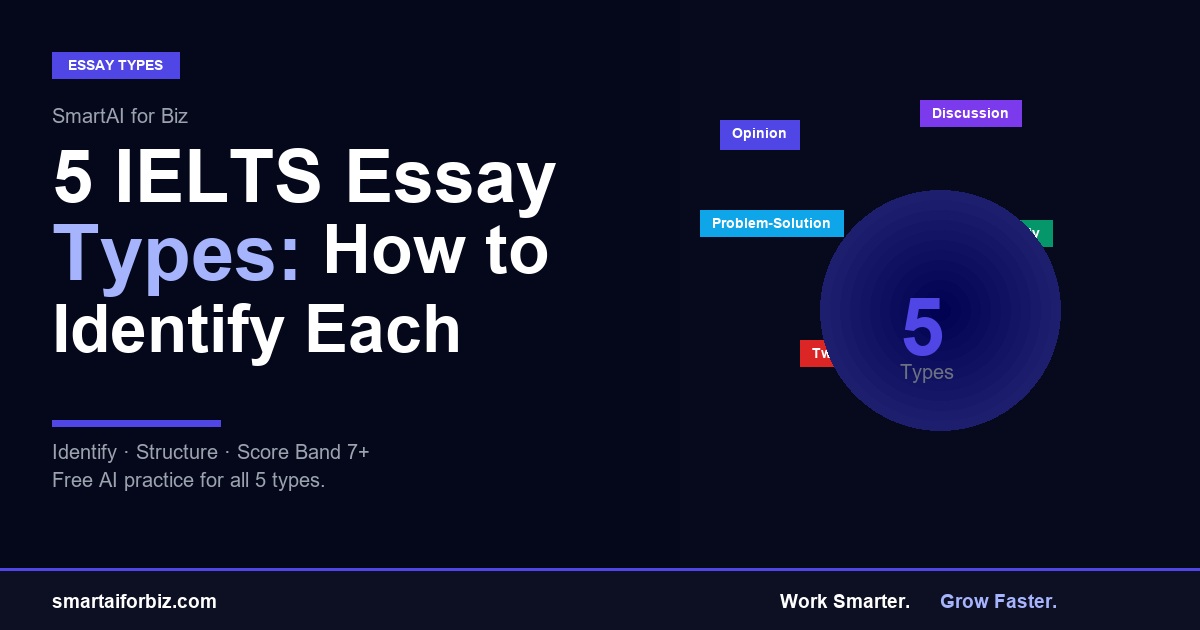
One of the most costly mistakes in IELTS Writing Task 2 is misidentifying the question type. Write a discussion essay when you should write an opinion essay and your Task Achievement score collapses — regardless of how good your vocabulary and grammar are. Identifying your essay type correctly in the first 30 seconds is the foundation of every Band 7+ response.
This guide covers all 5 essay types, how to identify each one from the question wording, and how to use free AI feedback to practise every type until the identification becomes automatic.
Why Essay Type Identification Matters
Each essay type requires a different structure, different content in each paragraph, and a different stance. Getting the type wrong means your essay answers a different question from the one asked — which is the definition of low Task Achievement. Examiners cannot give Band 7 Task Achievement if your essay doesn’t address what was asked.
The 5 IELTS Writing Task 2 Essay Types
| Essay Type | Question Keywords | Required Stance |
|---|---|---|
| Opinion (Agree/Disagree) | “To what extent do you agree or disagree?” | State a clear position and defend it throughout |
| Discussion | “Discuss both views and give your own opinion” | Present both sides AND your view |
| Problem & Solution | “What are the causes/problems? What solutions…?” | Identify problems in P1, solutions in P2 |
| Advantages & Disadvantages | “Discuss the advantages and disadvantages” | Balance both sides; reach a verdict |
| Two-Part Question | Two direct questions in the prompt | Answer both questions with equal weight |
Practise Every Essay Type With Free AI Feedback
Our tool has 265 Writing Task 2 questions across all 5 essay types. Write your essay and get instant feedback on whether your structure matches the question type.
✅ Instant band score
✅ No signup · Free
Essay Type 1: Opinion (Agree/Disagree)
Signal phrase: “To what extent do you agree or disagree?”
Your position: State clearly whether you agree, disagree, or partially agree in the introduction. Do not be vague. Examiners penalise non-committal openers like “There are many opinions about this topic.”
Structure:
- Introduction: Paraphrase topic + state your position clearly
- Body 1: First reason supporting your position + example
- Body 2: Second reason + counter-argument if partially agreeing
- Conclusion: Restate position + summary
Common mistake: “Partially agree” answers that spend equal time on both sides look like discussion essays and lose Task Achievement marks. If partially agreeing, make your main position clear and spend 60% of the essay on your dominant view.
Essay Type 2: Discussion (Both Views)
Signal phrase: “Discuss both views and give your own opinion”
Critical rule: You must give your own opinion — this is not optional. Many candidates present both sides but forget the personal view entirely. This directly caps your Task Achievement at Band 5.
Structure:
- Introduction: Acknowledge both views exist + state your own position
- Body 1: Arguments for View A
- Body 2: Arguments for View B
- Conclusion: Your opinion + reasons
Essay Type 3: Problem & Solution
Signal phrases: “What are the causes of this problem? What solutions can you suggest?” / “Why is this happening and what measures can be taken?”
Strict structure: Do not mix causes and solutions in the same paragraph. Examiners expect a clear separation.
- Body 1: 2–3 causes or problems (with explanations)
- Body 2: 2–3 solutions that directly correspond to the problems identified
Common mistake: Identifying a problem in Body 1 that has no corresponding solution in Body 2. Match each problem to a solution.
Essay Type 4: Advantages & Disadvantages
Signal phrases: “Discuss the advantages and disadvantages” / “What are the benefits and drawbacks?”
Important distinction: This is NOT an opinion essay. You must present both sides objectively. However, your conclusion should express a clear overall verdict — do the advantages outweigh the disadvantages, or vice versa?
Essay Type 5: Two-Part Question
Signal: Two explicit questions in the prompt (e.g., “Why is this happening? Is this a positive or negative development?”)
The most common mistake: Spending 80% of the essay on the first question and 3 sentences on the second. Both questions carry equal weight in Task Achievement. Allocate roughly equal paragraph space to each.
Structure:
- Body 1: Full answer to Question 1
- Body 2: Full answer to Question 2
Quick Identification Guide
| If the question says… | It is a… | Your introduction should… |
|---|---|---|
| “To what extent do you agree or disagree?” | Opinion essay | State clearly: I agree / I disagree / I partially agree |
| “Discuss both views and give your own opinion” | Discussion essay | Acknowledge both sides exist + state your view |
| “What are the causes? What solutions?” | Problem-Solution essay | State the problem is serious; you will examine causes and solutions |
| “Discuss the advantages and disadvantages” | Advantages-Disadvantages | Acknowledge both advantages and disadvantages exist |
| Two separate direct questions | Two-Part Question | Signal that you will address both questions |
Get AI Feedback on Your Essay Structure
Submit any Task 2 essay and our AI will tell you whether your structure matches the question type — and exactly how to fix it if not. Instant feedback. Free.
✅ Instant band score
✅ No signup · Free
Frequently Asked Questions
What if I’m not sure which essay type it is?
Look for the instruction verb: “agree or disagree” = Opinion. “Discuss both views” = Discussion. “Causes and solutions” = Problem-Solution. Two question marks in the prompt = Two-Part Question. If advantages AND disadvantages are explicitly mentioned = Advantages-Disadvantages.
Can I choose my own essay structure regardless of the question type?
No. Task Achievement is specifically assessed on whether you have addressed what the question asked. An opinion essay structure on a discussion question will lose significant Task Achievement marks.
Is there always exactly one correct essay type per question?
Yes — each Task 2 question has one correct essay type. The question wording is carefully designed to signal this. If you have practised identifying all 5 types with timed repetition, the correct type becomes obvious within seconds.