IELTS Academic Reading: 7 Question Types & Strategies 2026 + AI Practice
IELTS Academic Reading is where many high-scoring candidates are surprised by their results. The texts are dense, the questions are varied, and time management is brutal — 60 minutes for 40 questions across 3 passages, with no extra time to transfer answers. A strategic approach, not just reading ability, is what separates Band 7 from Band 8.
This guide covers the 7 question types, proven time management strategies, and how AI-powered practice can help you build the pattern recognition that high scores require.
IELTS Reading: The Key Facts
- 60 minutes for 3 passages and 40 questions (no extra transfer time)
- Passages increase in difficulty: Passage 3 is always the most complex
- Texts are taken from academic journals, magazines, and books
- Both Academic and General Training have 40 questions — but General texts are shorter and less academic
- Band 7 = approximately 30/40 correct answers
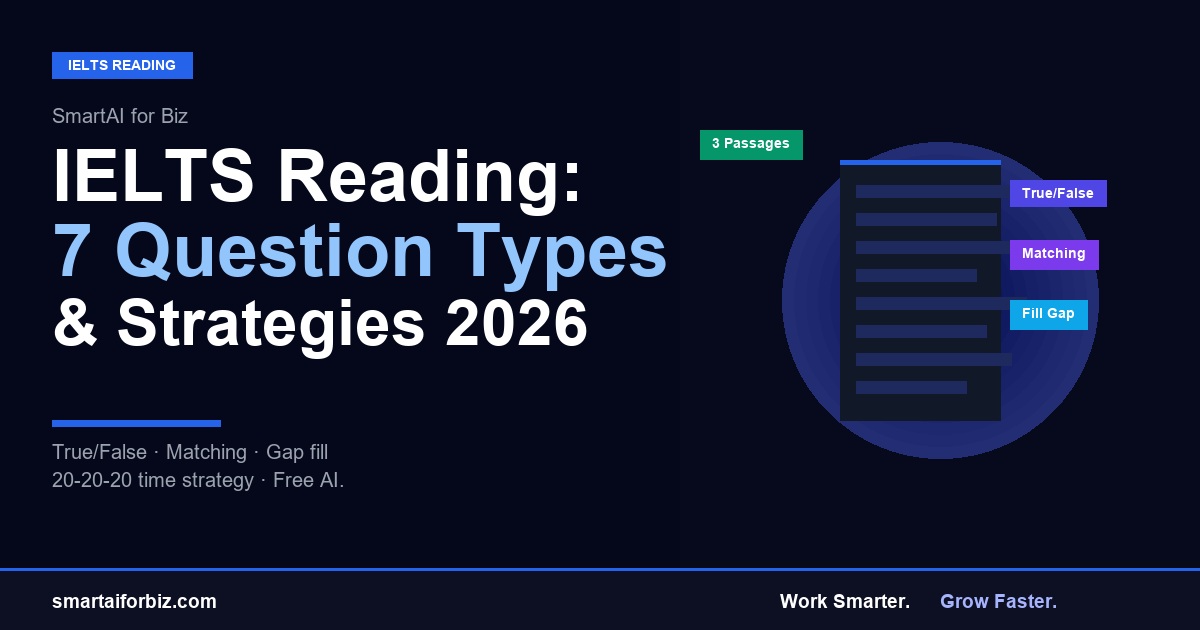
The 7 IELTS Reading Question Types
1. Multiple Choice
Choose one correct answer (A, B, C or D). Watch for paraphrased options — the correct answer rarely uses the exact words from the passage. Eliminate clearly wrong answers first.
2. True / False / Not Given
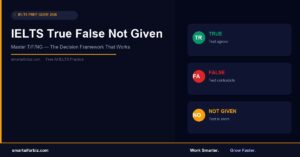
The most misunderstood question type. The key distinction: False means the passage directly contradicts the statement. Not Given means the passage neither confirms nor contradicts it — the information simply isn’t there. Do not use outside knowledge.
3. Yes / No / Not Given
Similar to True/False/Not Given but applies to the writer’s opinions and claims, not factual information. Yes = the writer agrees with the statement. No = the writer disagrees. Not Given = the writer doesn’t address it.
4. Matching Headings
Match each paragraph to a heading from the list. Read the first and last sentence of each paragraph — these carry the main idea. Ignore irrelevant details. Start with paragraphs that have the most distinctive content.
5. Matching Information / Features
Match statements to specific sections or names in the passage. These questions often do not follow the order of the text — scan rather than read linearly.
6. Sentence Completion / Summary Completion
Fill gaps with words taken directly from the passage (exact words, within word limit specified). Check the word limit carefully — “no more than two words” means one or two words only, never three.
7. Short Answer Questions
Answer in words from the passage within a specified word limit. Questions follow the order of the text — making this one of the more manageable question types once you locate the relevant section.
Build Reading Speed With AI-Guided Practice
Our IELTS tool includes practice passages and question types to sharpen your pattern recognition. Practice under timed conditions and get instant feedback on your approach.
✅ Instant band score
✅ No signup · Free
Time Management: The 20-20-20 Strategy
Allocate 20 minutes per passage — strictly. Many candidates spend 30 minutes on Passage 1 and run out of time on Passage 3, which is worth the same marks. Set internal time checkpoints:
- 0:00–20:00 — Passage 1 + all questions
- 20:00–40:00 — Passage 2 + all questions
- 40:00–57:00 — Passage 3 + all questions
- 57:00–60:00 — Transfer answers and check spelling (Academic paper-based only)
If you are stuck on a question after 90 seconds, mark your best guess and move on. An unanswered question is always zero; a guess has a probability of being correct.
The Scanning Technique for Faster Answers
Do not read passages fully before attempting questions — this wastes 8–10 minutes per passage. Instead:
- Skim the passage in 2–3 minutes — read the title, first paragraph, first sentence of each body paragraph, and final paragraph
- Read the questions first — identify keywords in each question
- Scan for keywords — look for names, numbers, dates, and capitalised words as locators
- Read the surrounding context carefully once you’ve located the relevant section
True/False/Not Given — The Strategy That Adds Half a Band
This question type has the lowest average score among all IELTS question types. The key rule:
If in doubt between False and Not Given, ask yourself: “Does the passage contain a statement that directly opposes what I’m reading?” If yes → False. If the passage simply doesn’t discuss it → Not Given. Your background knowledge about the topic is completely irrelevant.
Practice All 7 Question Types With AI Feedback
Our free IELTS tool helps you identify which question types cost you the most marks. Build pattern recognition with targeted practice and instant feedback.
✅ Instant band score
✅ No signup · Free
Frequently Asked Questions
Can I write on the question paper during the exam?
Yes — for paper-based tests, you can underline, circle and annotate the question paper freely. Only what you write on the answer sheet counts as your answer. For computer-based tests, a notepad is provided.
Does spelling matter in Reading answers?
Yes — spelling errors in fill-in-the-gap or short-answer questions result in the answer being marked wrong, even if the word is from the passage. Copy words from the passage exactly.
Is the Academic and General Reading band score calculated the same way?
Both have 40 questions. However, the General Training reading conversion table is slightly more lenient — Band 7 in Academic requires approximately 30 correct answers, while General Training typically requires around 34. The texts in General are shorter and more straightforward.