C2PA Explained: The New Standard That Tags Every AI Image in 2026
If you have generated an image with DALL-E, Adobe Firefly, or Canva AI in the last 12 months, your image carries a C2PA credential. You may never have heard of it — but in 2026, this standard is quietly reshaping how digital images are created, shared, and trusted online.
What Is C2PA?
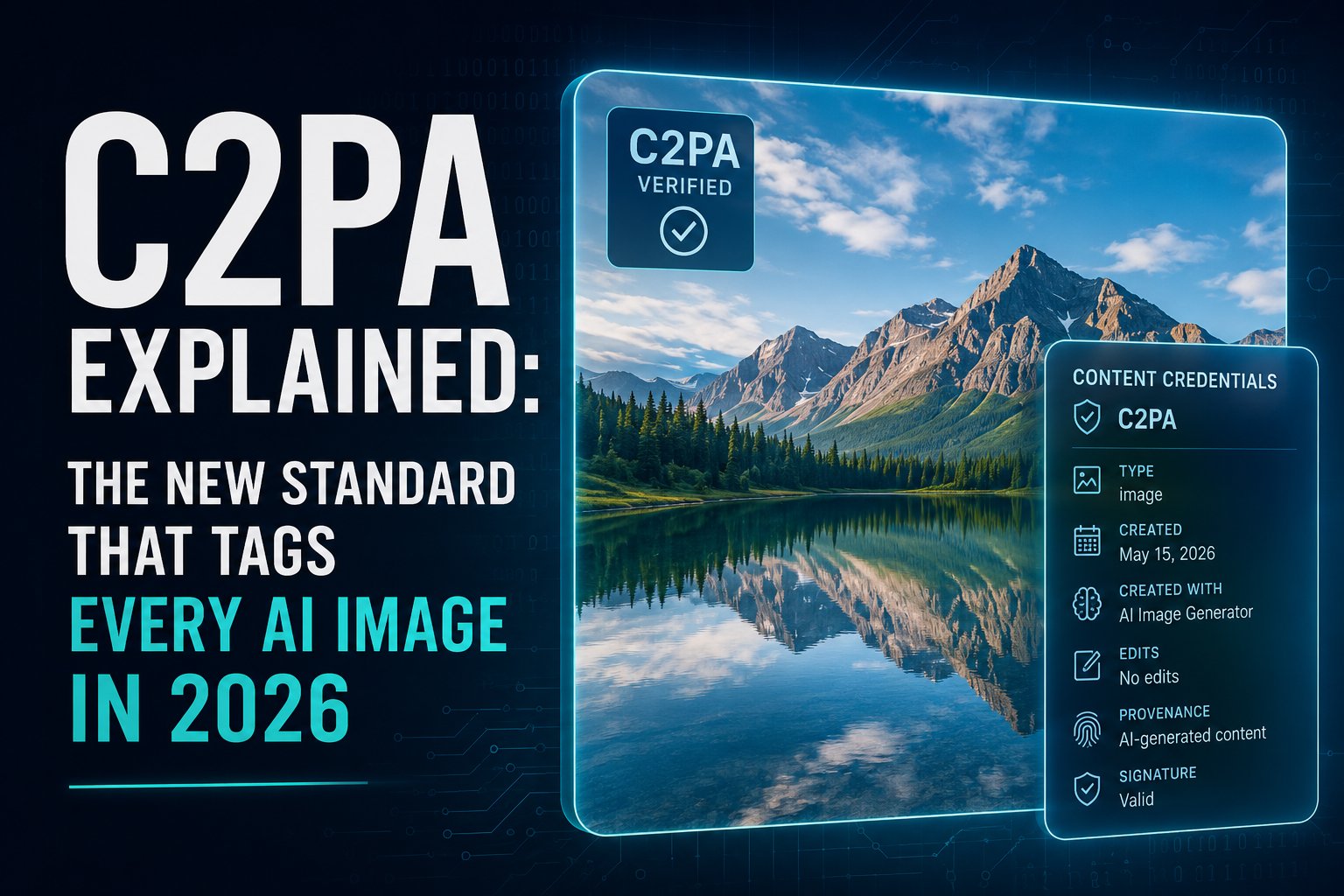
C2PA stands for the Coalition for Content Provenance and Authenticity. It is an open technical standard — think of it as a “digital nutrition label” for media files — that records the history of a piece of content: who created it, what tools were used, and what edits have been made. You can explore the full specification on the official C2PA website.
The standard was developed by Adobe, Microsoft, BBC, Intel, Truepic, and Arm, and has since been joined by OpenAI, Google, Sony, Nikon, Canon, and dozens of other companies.
How C2PA Works
When you generate an image with a C2PA-enabled tool, the application embeds a cryptographically signed “manifest” into the image file. This manifest contains:
- Assertions — statements about the content (e.g., “this was generated by AI”)
- Actions — a log of what happened (generated, edited, cropped, colour-adjusted)
- Ingredients — if the image used other images as inputs, those are referenced
- Claim generator — the software or service that created the credential
- Signature — a cryptographic signature that verifies the manifest has not been tampered with
This manifest is bound to the file in a way that survives most common editing operations — though not all (see below).
Who Uses This Standard In 2026?
AI Image Generators
- OpenAI DALL-E — content credentials on all outputs since April 2024
- Adobe Firefly — full support with Content Credentials badge in Creative Cloud
- Google Imagen / Gemini — the protocol plus SynthID dual watermarking
- Canva AI — provenance tagging on AI-generated elements since late 2025
- Microsoft Copilot Image Creator — credentials on all outputs
Camera Manufacturers
Nikon, Sony, and Leica have released camera firmware that embeds provenance credentials in photos at the moment of capture — creating a verifiable “born-real” certificate for photographs. This is particularly valuable for photojournalists and news organisations that need to verify image authenticity.
Platforms
Facebook, Instagram, LinkedIn, YouTube, and Google Images all read these credentials and display disclosure labels when AI-generated content is detected. The Content Authenticity Initiative (CAI) maintains a growing list of adopting platforms.
Can C2PA Credentials Be Removed?
Yes — but it is more complex than removing standard EXIF data. These credentials are stored in a dedicated section of the file structure (the JUMBF box for JPEG/HEIC, or equivalent for other formats). They survive basic editing but can be removed by:
- Dedicated metadata stripping tools that specifically target these structures
- Re-encoding the image (converting JPEG to PNG and back, for example)
- Screenshot or screen-capture of the displayed image (though this loses quality)
Our free AI metadata remover is one of the few browser-based tools that correctly handles C2PA credential removal along with EXIF, XMP, and IPTC.
Should You Be Concerned?
For most users, this is a background technology. It becomes relevant if you:
- Submit images to platforms or publications that flag AI content
- Want to maintain privacy about your creative workflow
- Are concerned about provenance information being used to identify your work
- Work in contexts where AI-generated content carries legal or contractual implications
Remove C2PA Credentials from Your Images — Free
Our browser-based tool is one of the few free tools that correctly removes these credentials along with all other AI metadata.