IELTS Writing Task 2: The Complete 2026 Guide (With Free AI Practice)
IELTS Writing Task 2 is the most heavily weighted section of the IELTS writing test — and the one that trips up the most candidates. It accounts for twice the marks of Task 1, and it requires you to produce a clear, well-argued essay of at least 250 words in just 40 minutes.
This complete guide covers everything you need to know: question types, essay structures, band 7+ strategies, vocabulary, common mistakes — and how to use free AI feedback to accelerate your improvement.
What Is IELTS Writing Task 2?
In IELTS Writing Task 2, you are given a statement, opinion or problem and asked to write a formal essay in response. The task applies to both Academic and General Training candidates.
Key requirements:
- Minimum 250 words (aim for 270–300)
- Time allocation: 40 minutes
- Worth double the marks of Writing Task 1
- Marked on 4 criteria — each worth 25% of your score
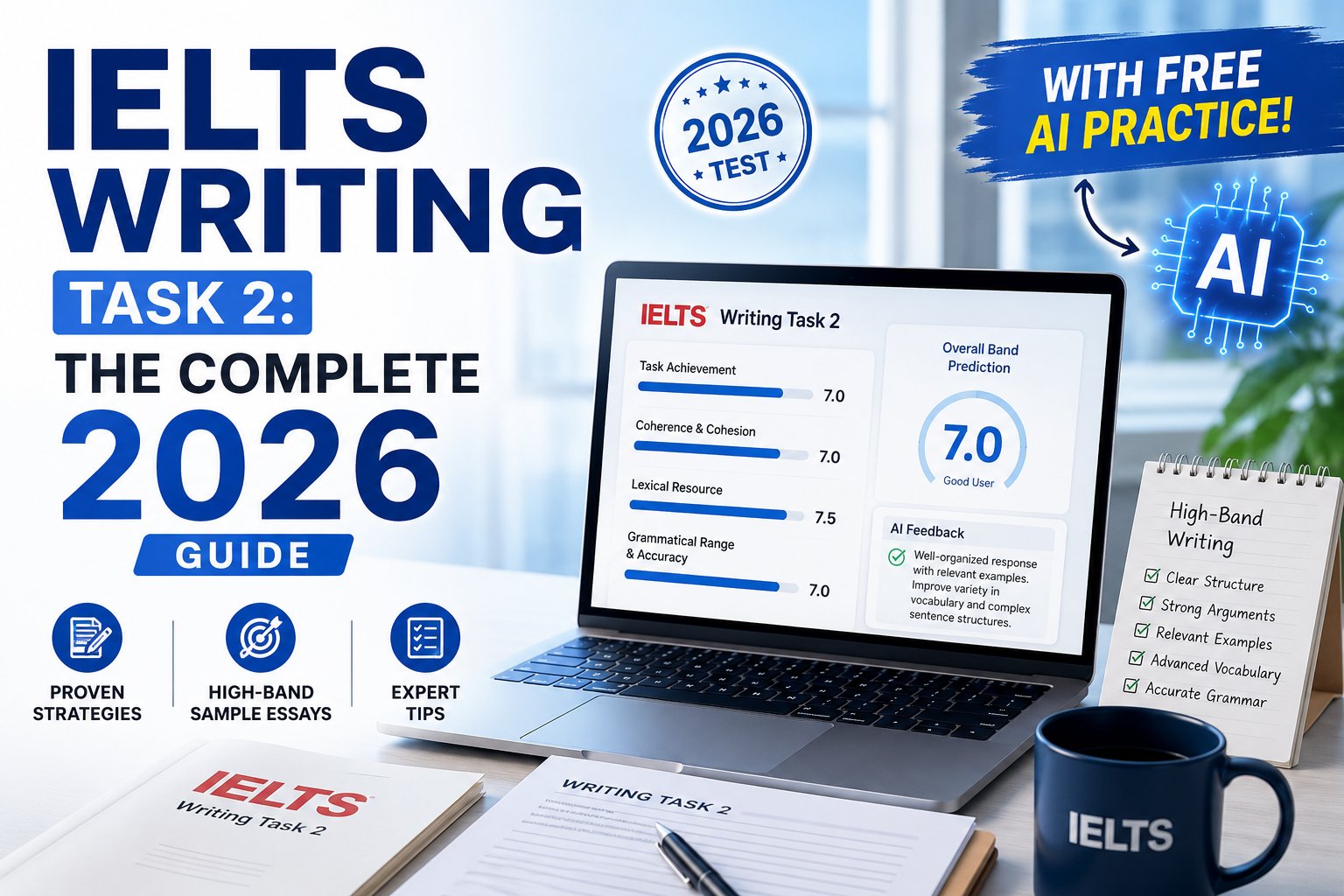
The 4 IELTS Writing Task 2 Marking Criteria Explained
Understanding exactly what examiners look for is the fastest route to a higher band score.
1. Task Achievement (25%)
Did you fully address all parts of the question? Did you present a clear position? Is your argument developed with relevant ideas and examples? This is where candidates most commonly lose marks — by misreading the question or giving an incomplete answer.
2. Coherence & Cohesion (25%)
Does your essay flow logically from one idea to the next? Do you use linking words and discourse markers effectively? Is your essay clearly organised into paragraphs? Examiners look for logical progression, not just a list of points.
3. Lexical Resource (25%)
How wide and accurate is your vocabulary? Can you use less common words naturally? Do you avoid repeating the same words? Paraphrasing the question in your introduction — rather than copying it — is an immediate signal to the examiner of your lexical range.
4. Grammatical Range & Accuracy (25%)
Do you use a variety of sentence structures — complex, compound, conditional, passive — correctly? Occasional errors are acceptable at Band 7, but your complex structures must generally be accurate.
The 5 IELTS Writing Task 2 Question Types
Knowing which question type you’re facing determines your entire essay structure. Misidentifying the question type is one of the most costly mistakes you can make.
1. Opinion Essay (Agree/Disagree)
“Some people believe that… To what extent do you agree or disagree?”
You must state a clear opinion in your introduction and maintain it consistently throughout. A partially-agree approach is acceptable but must be handled carefully to avoid appearing contradictory.
2. Discussion Essay (Discuss Both Views)
“Discuss both views and give your own opinion.”
You must present arguments for both sides AND give your own view. Three-paragraph body structure: View A → View B → Your opinion (or weave your opinion throughout).
3. Problem & Solution Essay
“What are the causes of this problem? What solutions can you suggest?”
Clearly identify causes (or problems) in one body paragraph and solutions in the second. Match each solution directly to the problem you identified.
4. Advantages & Disadvantages Essay
“Discuss the advantages and disadvantages of…”
Present balanced arguments for both sides. Your conclusion should reflect a clear overall position — not leave the reader without a verdict.
5. Two-Part Question
“Why is this happening? Is this a positive or negative development?”
Arguably the trickiest type — you must answer both questions fully. Allocate roughly equal paragraph space to each part.
Practice Any Essay Type With Free AI Feedback
Now that you know the 5 question types, practise them with real AI feedback. Our free tool gives you an instant band score and examiner-style comments on your essay.
✅ Instant band score
✅ No signup · Free
The Band 7+ Essay Structure (Works for All Question Types)
Every high-scoring IELTS Task 2 essay follows a clear 4-paragraph structure:
Introduction (40–60 words)
- Sentence 1: Paraphrase the topic (do NOT copy the question)
- Sentence 2: State your clear position / overview of what you will discuss
Body Paragraph 1 (90–120 words)
- Topic sentence: State your main point clearly
- Explanation: Explain why / how this is the case
- Example: Support with a specific, relevant example
- Link: Connect back to the question or lead into Paragraph 2
Body Paragraph 2 (90–120 words)
Same structure as Body Paragraph 1, developing a second distinct point.
Conclusion (30–50 words)
- Restate your position (using different words)
- Summarise your two main points briefly
- Do NOT introduce any new ideas
Essential Band 7+ Vocabulary for IELTS Writing Task 2
Vary your linking expressions beyond “firstly” and “however.” Here are examiner-approved alternatives:
| Function | Band 5–6 Phrases | Band 7+ Alternatives |
|---|---|---|
| Adding a point | Also, And | Furthermore, In addition, Moreover |
| Contrasting | But, However | Nevertheless, Conversely, On the other hand |
| Giving a reason | Because | Given that, Owing to the fact that, This is largely due to |
| Giving an example | For example | To illustrate, This is evidenced by, A case in point is |
| Concluding | In conclusion | To summarise, On balance, Taking everything into consideration |
The 10 Most Common IELTS Writing Task 2 Topics in 2026
These topics appear most frequently in real IELTS exams. Make sure you have arguments prepared for both sides of each:
- Technology & Artificial Intelligence — AI replacing jobs, social media impact, screen time
- Environment & Climate Change — individual vs government responsibility, renewable energy
- Education — university vs vocational training, online learning, curriculum design
- Health & Lifestyle — diet, exercise, healthcare systems, mental health
- Globalisation — cultural homogenisation, international trade, migration
- Work & Employment — remote work, gender pay gap, work-life balance
- Crime & Punishment — rehabilitation vs deterrence, capital punishment
- Media & Communication — fake news, advertising, social media influence
- Family & Society — ageing population, changing family structures, gender roles
- Transport & Urban Development — traffic congestion, public transport, smart cities
7 Mistakes That Keep Candidates Below Band 7
- Copying the question word-for-word in the introduction — this is flagged and penalises your Lexical Resource score
- Not stating a clear opinion — vague or non-committal positions hurt Task Achievement
- Writing only one long body paragraph — this destroys your Coherence & Cohesion score
- Using the same linking words repeatedly — “firstly… secondly… finally” throughout an essay signals Band 5–6 range
- Writing under 250 words — you are penalised automatically for under-length responses
- Introducing new ideas in the conclusion — your conclusion must only summarise what you already argued
- Spending too long on Task 1 — Task 2 is worth twice as much. Always leave 40 minutes for it.
How to Use AI Feedback to Improve Your Task 2 Score Fast
The fastest way to improve your IELTS Writing Task 2 score is through high-volume deliberate practice with immediate feedback. Here’s the most effective daily routine:
- Pick a question from our 265 Writing Task 2 questions (filtered by type and difficulty band)
- Set a timer for 40 minutes and write your essay under exam conditions
- Submit for AI feedback — receive your band score across all 4 criteria instantly
- Read every correction and comment carefully
- Rewrite any weak paragraphs based on the feedback
- Repeat with a new question the following day
Students who follow this routine consistently typically see a 0.5–1.0 band improvement within 4–6 weeks.
Ready to Write Your First Essay?
Use our 265 Writing Task 2 questions with instant AI feedback. Get a band score in seconds — no signup, no cost. Students see a 0.5–1.0 band improvement in 4–6 weeks of daily practice.
✅ Instant band score
✅ No signup · Free
Frequently Asked Questions
How long should IELTS Writing Task 2 be?
A minimum of 250 words is required. Aim for 270–300 words. Going significantly over 300 words rarely improves your score and risks introducing more errors. Quality over quantity.
What is the difference between IELTS Academic and General Writing Task 2?
The question types and marking criteria are identical for both Academic and General Training. The topics in Academic tend to be slightly more formal or abstract, but the essay structure and band descriptors are the same.
Can I use “I” in IELTS Writing Task 2?
Yes. Opinion essays require you to state your view, and using “I believe,” “In my opinion,” or “I would argue” is perfectly acceptable and expected. However, avoid casual first-person language like “I think that maybe…”
How is IELTS Writing Task 2 scored?
Task 2 is scored across four criteria — Task Achievement, Coherence & Cohesion, Lexical Resource, and Grammatical Range & Accuracy — each worth 25% of the Task 2 score. Because Task 2 is worth double Task 1, it has a greater impact on your overall Writing band score.
What band score do I need for a UK visa or university?
Most UK universities require a minimum Writing band of 6.0–7.0. UK Skilled Worker visas typically require an overall Band 6.0+. Always check the specific requirements of your institution or visa category.