Notion AI vs ChatGPT 2026: Which One Should Your Business Use?
Over 90% of businesses using AI tools are making the same critical mistake: they’re choosing tools based on popularity rather than function. The result? Thousands of wasted hours and mediocre results that could have been avoided with a simple decision framework.
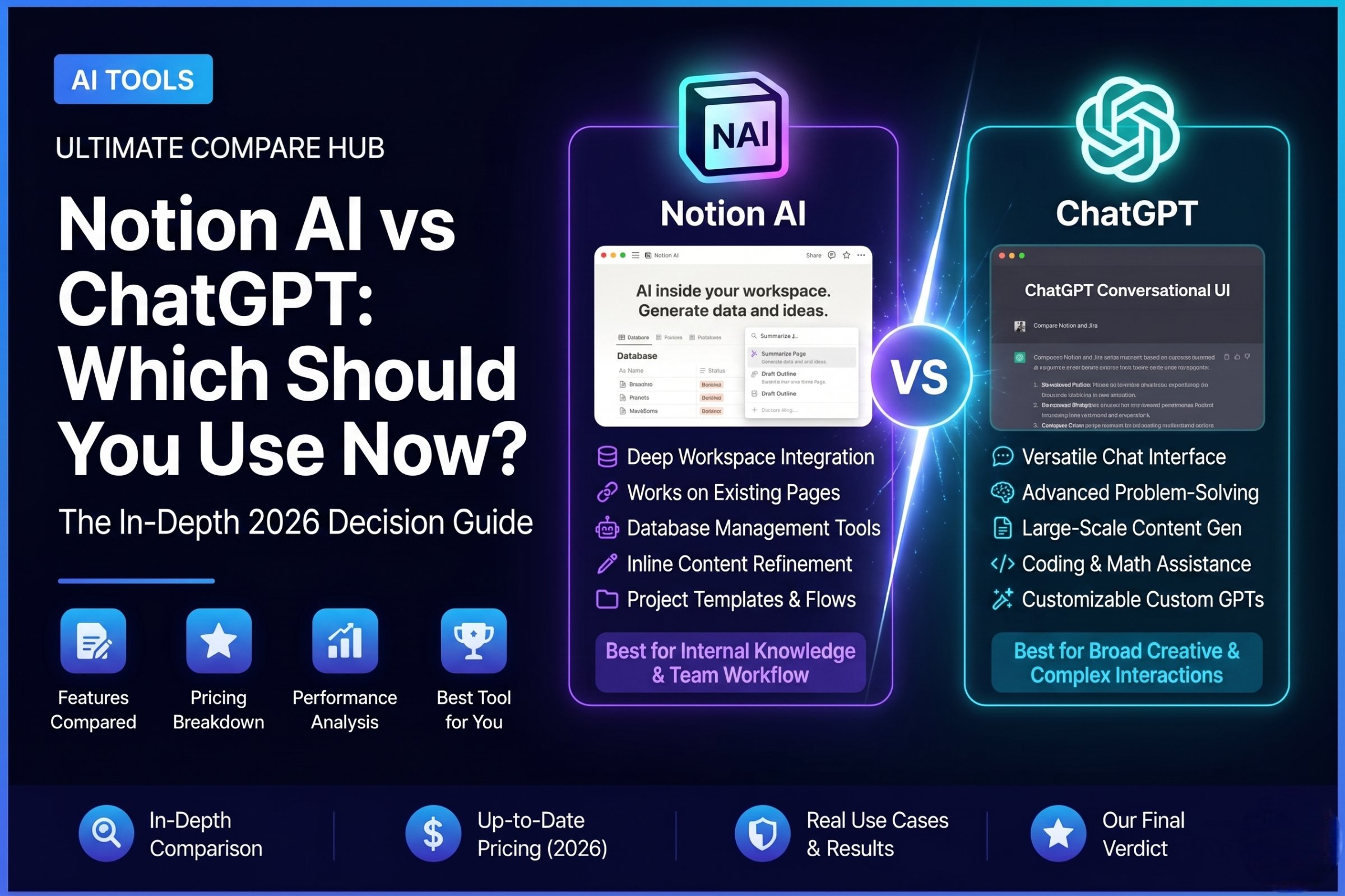
The battle between Notion AI vs ChatGPT 2026: Which One Should Your Business Use? which tool to choose has become one of the most debated topics in business AI circles. Both platforms promise to revolutionize your workflow, but they serve fundamentally different purposes — and picking the wrong one could derail your productivity goals for months.
Here’s the truth most “experts” won’t tell you: Neither tool is universally better. The right choice depends entirely on your specific business needs, workflow preferences, and long-term strategy. Let’s cut through the marketing noise and examine what each platform actually delivers in 2026.
What Makes Notion AI Different from ChatGPT
Notion AI isn’t trying to be ChatGPT, and that’s precisely its strength. While ChatGPT excels as a standalone conversational AI, Notion AI integrates seamlessly into your existing workspace ecosystem, making it a workflow enhancer rather than a separate tool you need to juggle.
The core difference lies in context and continuity. Notion AI understands your project history, team dynamics, and document relationships because it lives inside your workspace. ChatGPT, despite its superior language capabilities, starts fresh with every conversation unless you’re using custom GPTs or advanced prompt engineering.
Think of it this way: ChatGPT is like hiring a brilliant consultant for one-off projects, while Notion AI is like having an AI assistant who’s been working with your team for months and understands your company’s unique rhythm and requirements.
ChatGPT’s Core Advantages for Business Users
ChatGPT’s strength lies in its raw processing power and versatility. The platform excels at complex reasoning, creative problem-solving, and handling nuanced business scenarios that require deep analysis. Its training data is more comprehensive, making it superior for research, strategy development, and creative brainstorming.
For businesses requiring sophisticated content creation, ChatGPT consistently outperforms Notion AI. Whether you’re developing marketing campaigns, writing technical documentation, or crafting investor pitches, ChatGPT’s language model produces more polished, contextually aware results.
The platform’s plugin ecosystem and GPT store also provide specialized functionality that Notion AI simply can’t match. From data analysis to industry-specific applications, ChatGPT’s extensibility makes it the clear winner for businesses with diverse AI needs.
🚀 Ready to supercharge your AI workflow?
Stop wasting hours on bad prompts. Our free AI Prompt Generator creates professional, optimized prompts for ChatGPT, Claude and Gemini in seconds — no signup required.
When Notion AI Outperforms ChatGPT
Notion AI shines in workflow integration scenarios where context switching kills productivity. If your team already lives in Notion for project management, documentation, and collaboration, adding AI capabilities within the same environment eliminates the friction of jumping between platforms.
The platform excels at routine business tasks: summarizing meeting notes, updating project statuses, and maintaining consistent formatting across documents. These aren’t glamorous use cases, but they represent 70% of daily business AI interactions according to recent productivity studies.
Notion AI’s database integration capabilities are particularly powerful for businesses managing complex projects or client relationships. The AI can automatically populate fields, suggest next actions based on project status, and maintain data consistency across multiple workspaces — functionality that requires significant manual setup with ChatGPT.
Pricing Reality Check: Total Cost of Ownership
The pricing conversation goes deeper than monthly subscription fees. ChatGPT Plus costs $20/month per user, while Notion AI adds $10/month to your existing Notion subscription. But these numbers don’t tell the complete story.
ChatGPT’s true cost includes time spent context-switching, prompt engineering, and integrating outputs back into your existing workflow. For teams processing high volumes of routine tasks, this “hidden time tax” can add 15-20 minutes per team member per day.
Notion AI’s integrated approach eliminates most context-switching costs but limits you to Notion’s ecosystem. If your team uses multiple productivity platforms, you might find yourself paying for both tools anyway — making the cost comparison more complex than it initially appears.
- ChatGPT advantage: Lower barrier to entry, pay-per-user scaling
- Notion AI advantage: Bundled efficiency gains, reduced tool sprawl
- Hidden costs: Training time, integration complexity, workflow disruption
🎯 Want honest feedback on your business idea?
Pitch your startup to 5 legendary entrepreneurs — Elon Musk, Warren Buffett and more — powered by Claude AI. Free, no limits, brutally honest.
Team Collaboration and Scaling Considerations
Scaling AI adoption across teams reveals stark differences between these platforms. ChatGPT requires individual skill development — each team member needs to learn prompt engineering, understand the tool’s limitations, and develop their own workflow integrations.
Notion AI, conversely, scales through shared workspace knowledge. When one team member creates an effective AI-powered template or workflow, it immediately benefits the entire organization. This collaborative learning effect accelerates adoption and maintains consistency across departments.
However, this integration strength becomes a weakness for distributed teams using diverse productivity tools. ChatGPT’s platform-agnostic approach means it works equally well whether your team uses Slack, Microsoft Teams, Google Workspace, or any other collaboration platform.
Security and Data Privacy Comparison
Enterprise security requirements often determine tool selection regardless of functionality preferences. Both platforms offer business-grade security, but their data handling approaches differ significantly.
ChatGPT processes conversations independently, making it easier to control data exposure and maintain compliance with industry regulations. Notion AI’s workspace integration means it has access to broader organizational context, which can be either a security advantage or liability depending on your perspective.
For highly regulated industries, ChatGPT’s compartmentalized approach often wins. For organizations prioritizing AI context and intelligence, Notion AI’s integrated access provides superior functionality at the cost of increased data exposure surface area.
The Verdict: Choose Based on Your Primary Use Case
Stop trying to find the “best” tool — it doesn’t exist. Choose based on where you spend most of your AI time and what problems you’re actually trying to solve.
Choose ChatGPT if:
- You need sophisticated reasoning and creative problem-solving capabilities
- Your team uses diverse productivity platforms and needs platform-agnostic AI
- You’re willing to invest in prompt engineering skills for maximum customization
Choose Notion AI if:
- Your team already lives in Notion for project management and documentation
- You prioritize workflow efficiency over raw AI capability
- You want immediate productivity gains without extensive training or setup
📦 Get 500+ battle-tested AI prompts for your business
Stop reinventing the wheel. Our Professional Prompt Packs cover marketing, copywriting, finance and e-commerce — used by thousands of entrepreneurs worldwide.
The notion chatgpt which tool debate misses the real point: successful AI adoption isn’t about choosing the most powerful tool — it’s about choosing the tool that your team will actually use consistently. In 2026, the businesses winning with AI are those that picked the platform that matched their existing workflows and committed to mastering it completely, rather than constantly chasing the latest AI capability or feature.